


My shop’s first review was 1 star. Here’s how I still made $20,065





Imagine spending MONTHS making your product and building your online store from scratch. You’ve poured your time, energy, and hope into getting everything ready for launch.
And then your very first customer leaves a one-star review.
That’s exactly what happened to me.
My new shop’s very first review was one star. No easing into it.
No “this could be better.” Just a straight one-star review right from the start.
Then things didn’t really get better right away.
The second order came in, and that customer ended up returning the product and asking for a refund.
So in the very beginning, my shop had already experienced both a one-star review and a return.
But even with that start, this same shop has still made me $20,065 to date.

What most people get wrong about bad reviews
So what happened?
The customer isn’t always right, so I’m not going to tell you I listened to my customers and then sales magically went up.
Most people either fall apart when they get bad reviews, or they completely overhaul everything they’ve built.
And neither of those is the right move.
So let’s walk through how you actually deal with bad reviews using real examples from my own shop.
And I’ll even show you one review that was so unhinged, I had to keep the screenshots.
If you sell anything online whether it’s handmade products, digital downloads, services, or even if you’re driving for Uber, you’ve probably dealt with this.
You work so hard to create something great. You pour everything into it and then one bad review comes in and suddenly you’re questioning everything you’ve built.
I’ve been selling online for 20 years now. I’ve made millions from my self-designed products and handmade work.
And I STILL felt that sting when the first review for my newest shop, the Bright Jewel, came in as a one-star.
So if you’ve felt that sting? That’s completely normal.
It does get easier over time, but for me, it hasn’t completely gone away. I’m a sensitive, emotional person, you know how it is.
And honestly, I think that just means I care.
But caring and acting on feedback are two very different things and that’s really what we’re going to talk about here: when to act, and when to let it go.
Because it doesn’t stop at customers.
On top of that, you’ve got your family giving opinions, your friends suggesting changes, random strangers telling you what you should do differently.
And suddenly you’re drowning in feedback coming at you from ten different directions.
It gets overwhelming fast and the truth is, not all feedback deserves your attention.
Learning what to act on, what to file away, and what to completely ignore is honestly one of the most valuable skills you can build as a creative business owner.
My First One-Star Review
So what happened with that first review?
The Bright Jewel is where I sell 18k gold plated jewelry.
I work with a manufacturer who takes my designs and creates custom charms for me, and then I hand assemble everything here before shipping it out.
It’s a smaller shop compared to my other businesses, but it brings in passive sales, meaning I don’t actively market it, and the sales just come in on their own.
And I actually love that part of it, curating the designs, building the product line, shaping the branding, taking product photos, all of that is genuinely creative work for me.
The first customer who bought from The Bright Jewel ordered a pair of earrings.
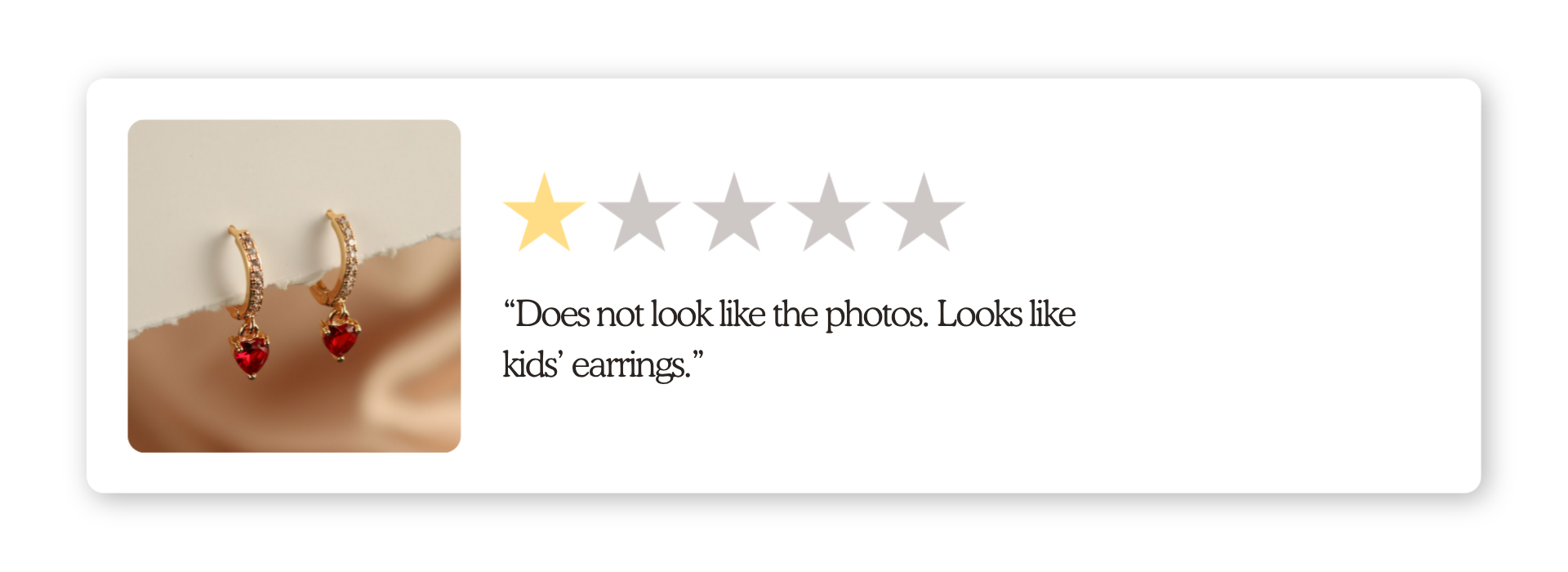
She left a one-star review saying the earrings didn’t look like the pictures.
That they looked like kids’ earrings.
For my very first sale, that was PAINFUL to hear.
So of course, I spiraled a bit, that review took up almost all of my mental space for the next few days.
Then I went back and looked at the photos, I compared them directly to the actual product, just to see if there was even a glimmer of truth in what she said.
And here’s what I decided.
Her opinion was valid, she didn’t like them but when I looked at the earrings next to the photos, I genuinely disagreed with her assessment.
To me, they looked like the photos, they were well-made, they had a nice weight to them, the hooks had good movement, and the crystals had a real sparkle that wasn’t anything like cheap plastic.
They weren’t kids’ earrings.
So I made zero changes to that listing and I think this is actually a skill we learn as business owners, right?
It’s not easy, but when feedback comes in, you have to step back and ask yourself two questions: first, is this person my ideal customer? And second, is this feedback accurate?
In this case, I didn’t think so. So, agree to disagree.
Some people just have wildly different expectations compared to reality, and when those two don’t match, people get upset.
But here’s where it gets more interesting, because not all feedback I’ve gotten has been like that.
Some of it was completely right. And that’s what makes this part hard.
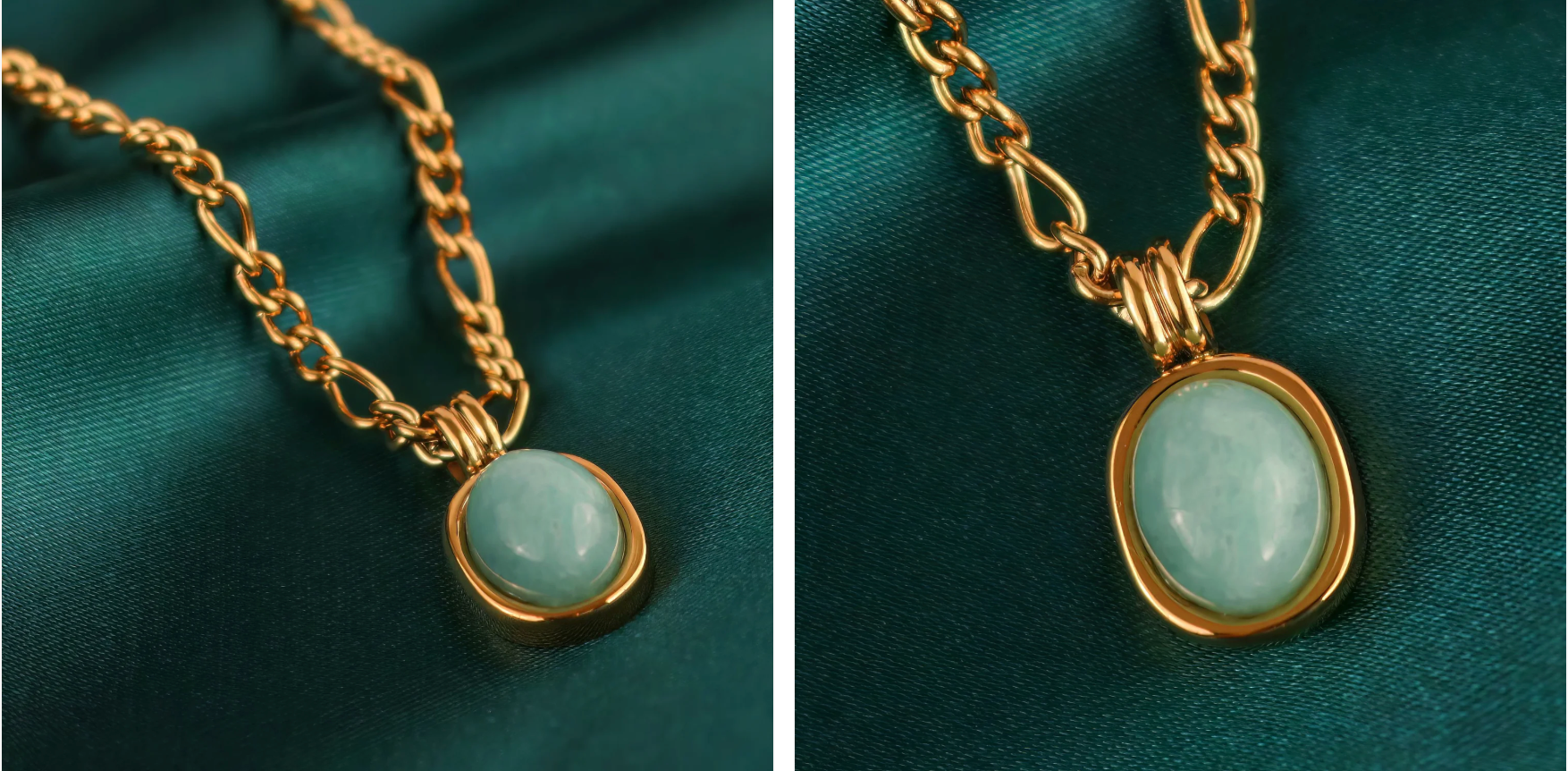
The second order I got was for an amazonite necklace, the customer messaged me and said the color in the photo looked different from what he received.
He said it looked more bluish in real life than what the photos showed.
And of course, the first thought I had was: oh my god, is this shop doomed to fail? What’s wrong with it? Do I have a really bad product?!
Which is super disappointing, right? Because I spent months creating this business.
But like the first review, I went back and looked.
And honestly? He was right, the photo made it look more green than it actually was in person.
So I changed it. I updated the listing, fixed the photos, and made sure the color was represented accurately.
That’s the difference.
One review came in and I evaluated it and said no, this doesn’t reflect reality.
Another feedback came in, and I evaluated it and said yes, this is a real issue, and I should fix it.
Both times, I looked at the feedback objectively. Both times, I got emotional, but I still made decisions based on what I actually saw, not based on my emotions or my fear of bad reviews.
And that’s the framework I want you to use every time feedback comes your way.
How I decide if customer feedback is worth acting on
Now I want to share something that happened more recently because it is wild, and honestly, kind of funny in a painful way.
I’m going to show you a screenshot because you really have to see this for yourself.
I had a customer over Valentine’s Day order a scented heart and taco necklace from me. She received them, left her review, and wrote:
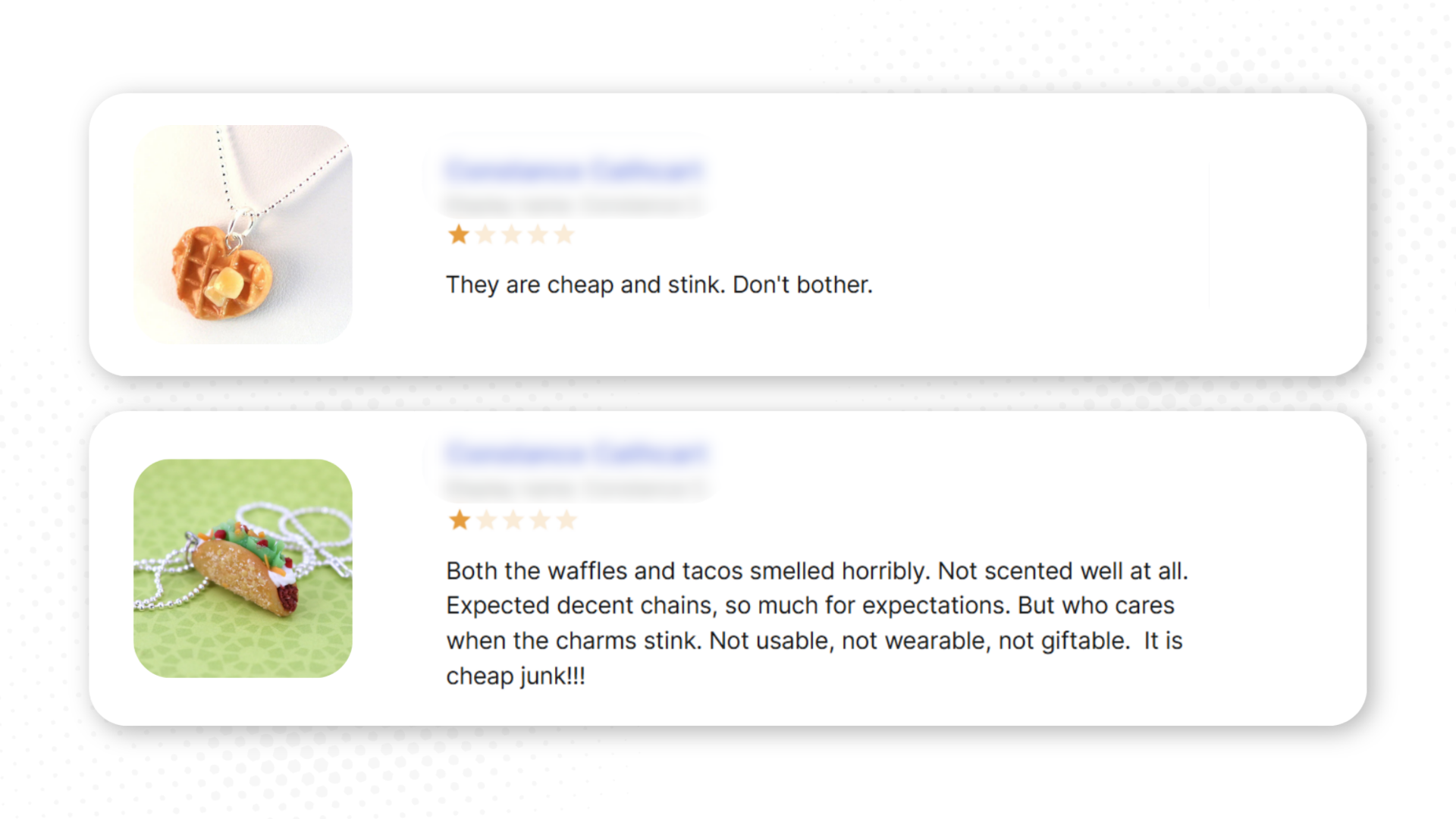
“They are cheap and stink. Don’t bother.”
And then she went on to say the waffle and taco charms smelled horrible, the chain was too thin, they were not usable, not wearable, not giftable, and ended it with: “It is cheap junk.”
As if that wasn’t bad enough because obviously my products are SO BAD and thousands of previous happy customers are wrong, four minutes later she changed the first review to:
“Not a scent, absolute stench.”
Which is, like contradictory? Did it smell, or did it not?
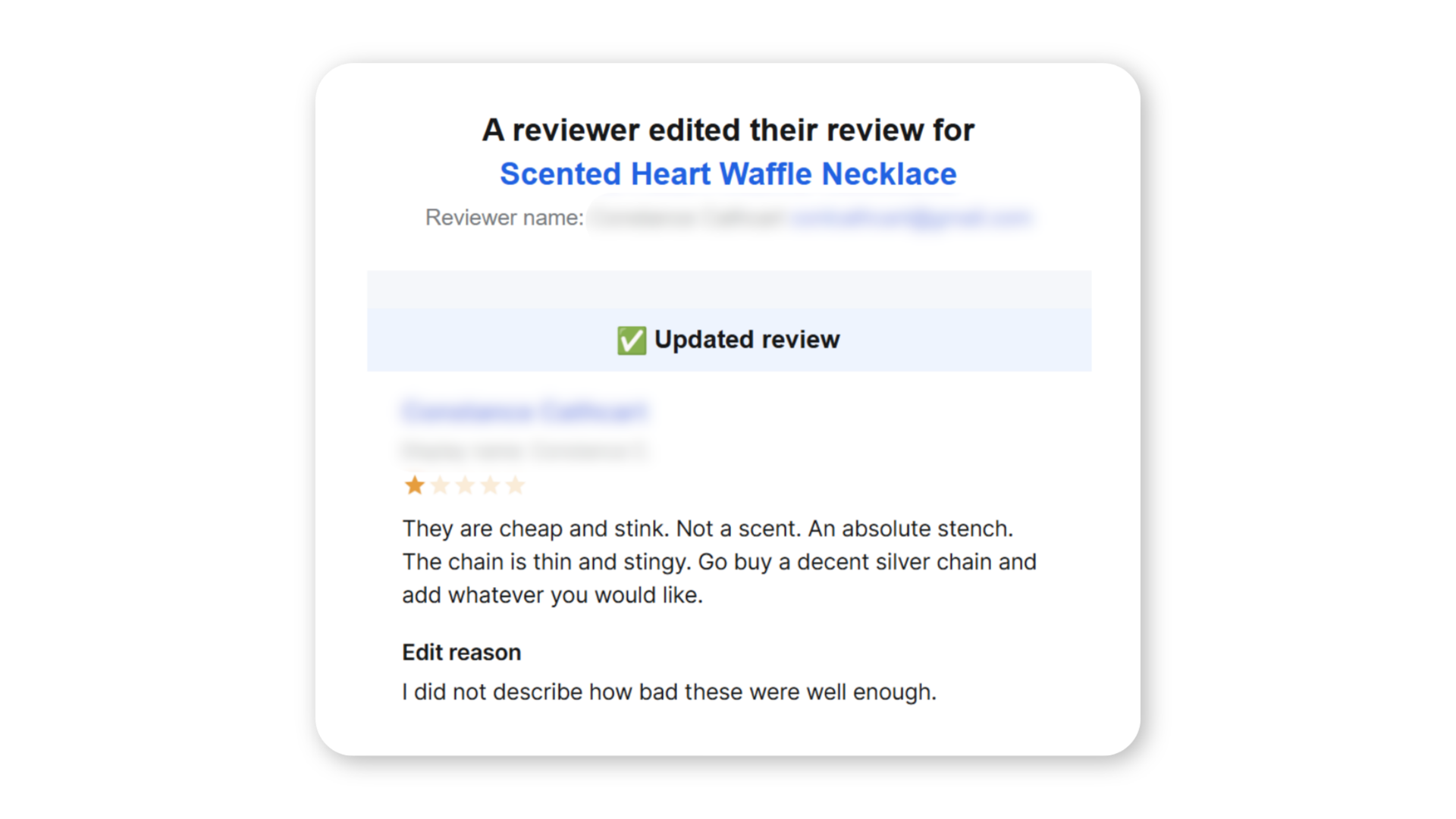
She said, “I did not describe how bad these were well enough.”
Now look, there are a few things going on here.
First of all, our charms are scented, that’s a product feature but scent is deeply personal.
What one person finds delightful, another person finds overpowering or unpleasant.
So there may be something real in there about whether the scent was enjoyable to her specifically.
But here’s what she didn’t do.
She didn’t email us.
In every order I send, I include a message asking customers to reach out to me directly if there’s a problem, I want to fix it, that’s genuinely my goal.
And she had every opportunity to do that but instead, she chose to update her review twice to make it as scathing as possible.
And that tells me a lot about the feedback.
When someone won’t give you a chance to make it right, when they go out of their way to be cruel, that’s not really feedback.
That’s someone having a bad day, with completely unrealistic expectations, and taking it out on a small business.
And I want to pause here because this is actually the most important part of what I want to tell you today.
You are not supposed to make everyone happy.
You have an ideal customer, someone who loves what you make, values the craft behind it, and is genuinely excited to receive it.
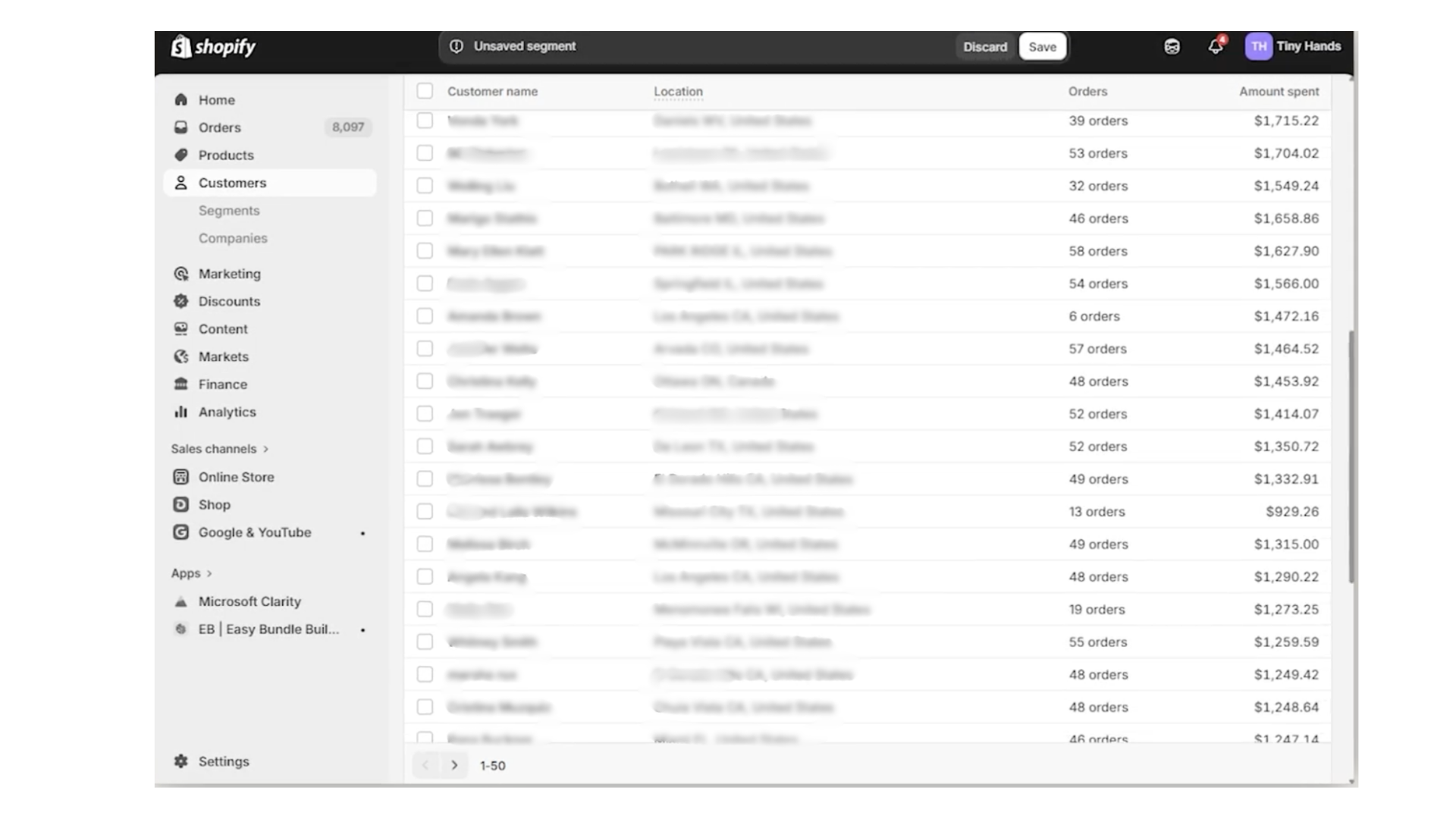
That person exists and I know she exists because I have plenty of customers who love their orders, come back again and again, and have spent thousands of dollars in my shop over the years.
When someone who is not your ideal customer buys your product and doesn’t like it, that’s almost guaranteed to happen.
You didn’t make it for them, that’s a mismatch and your craft is fine, they were just never the right buyer.
And your goal should never be to get 100% five-star reviews anyway.
I know that sounds counterintuitive, but to get a five-star review from every single person, you’d have to make a product that’s so bland and so safe it pleases no one.
You’d have to strip out everything that makes it special, different, or opinionated.
Also, it’s basically impossible, so don’t even bother.
If you’re a 4.5 or 4.7 star business, that’s actually super healthy and doesn’t need fixing.
The people who love your work love it because of the specific choices you made as the artist.
And those same choices are exactly why some people won’t love it, that’s fine. That’s the correct thing to do in business.
And if you want to go deeper on how to find more of those right people without relying on Etsy or posting on social media every day, I have a free workshop where I walk you through my roadmap for making consistent $1,000 sales months selling your work online.
Here’s the link to join: https://tinyurl.com/387vtwbd
Feedback from family and friends
So we’ve talked about customer feedback but there’s another kind of feedback that can be just as overwhelming and honestly, sometimes even harder to deal with.
And that’s the feedback you get from people close to you.
When you start sharing your business journey with family and friends, you’re going to get opinions.
People will tell you what you should sell, how you should price it, what platform you should be on, what your branding should look like.
Most of them mean well.
But this is your permission slip, in case you need to hear it, you don’t have to take action on ANY of it… unless it’s actually good advice.
Because the reality is, most people aren’t business owners themselves, a lot of the feedback they give you is based on something they saw in a random Instagram reel.
Here’s what I say when someone gives me unsolicited advice that I probably won’t use:
“Thank you, I really appreciate that you’re thinking about me and the business. I’ll think about it.”
That’s it.
You accept it, you thank them, and you move on.
You don’t owe anyone an update on whether you followed their suggestion, you don’t have to explain your decisions, just receive it graciously and let it go.
You are the business owner, the leader, the CEO, not them.
So unless they’re investing in your business and actually have equity in it, they don’t get a say.
And I say this because I know how quickly you can get buried in other people’s ideas for your business.
It gets overwhelming, gets noisy and you have to be able to filter out that noise so you can actually hear the signal.
Filter customer feedback to make better decisions
So what is the signal? How do you know when feedback is actually worth listening to?
Here’s the rule I use.
If one ideal customer tells you they wish you made a specific product, or a variation of something you already sell, take note of it.
File it away but don’t drop everything to do it.
If three to five ideal customers say the same thing, that’s a pattern. And you should pay attention, that repeated feedback might be your next bestseller waiting to happen.
One person saying, “I wish you had this in green,” is just one person, five people saying it is a market signal.
So here’s a simple system for tracking this.
- Keep a spreadsheet, every time a customer makes a suggestion or requests something you don’t carry, write it down.
- Put a tally next to it
- At the end of every few months, look at what has accumulated.
Anything that shows up once doesn’t need to be acted on yet, anything that keeps showing up, though, consider making that item.
This takes the guesswork out of product decisions and people’s feedback, because you’re no longer just reacting to whoever was loudest.
You’re responding to actual patterns in what your buyers want.
I want to come back to something I mentioned at the beginning because I don’t want to gloss over it.
Getting a one-star review on something you poured your heart and soul and spirit into really hurts.
Even if you know logically that not all feedback is accurate, even if you know this person wasn’t your ideal customer, it still hurts.
Creative people feel this differently than other business owners.
When you make something by hand, or you spend weeks on a design, or you pour yourself into building a shop, the product carries a piece of you.
So when someone says it’s bad, it doesn’t just feel like a product critique, it can feel personal.
I’ve been doing this for 20 years, I’ve made millions of dollars in sales from my creative businesses and I still feel crummy when I get a bad review.
So if you were upset by your first bad review, or your first return, or someone’s nasty comment on a product you made with your bare hands, I want you to know, you’re not too sensitive, okay?
Despite what other people might have said about you, you just care about your work and that’s actually a good thing.
We just need to make sure that caring doesn’t turn into letting one unhappy person make your business decisions for you.
When you get a bad review, pause before you react.
The emotions are totally normal, just give yourself time and space to process them.
Once you’re ready, ask yourself if this person is your ideal customer, ask yourself if the feedback is actually accurate and then decide.
You’re going to get bad reviews, every person selling anything does and even the most loved brands like Disney, Apple, or Costco all get bad reviews.
The question is what you do with them.
If you can learn to filter the feedback that moves you forward from the noise that brings you down, you’re going to be okay.
So how do you get more of the right people finding you in the first place?
One of my students, Anuja had been selling for years and kept hitting the same ceiling, she couldn’t break through.
Until she made one change that felt completely backwards. In just three months, she made more sales than she had in the entire previous year!
Read her journey here: https://tinyurl.com/pppkem7h
Stay grounded in who your ideal customer is, stay honest about what’s actually accurate, and keep making decisions from that place. Because the goal was never to please everyone. The goal is to build something that works, something that sells, and something you’re proud of and that only happens when you learn to separate what truly matters from everything else.

Unlock a Profitable Handmade Business
in Just 12 Weeks Without Using Etsy
or Social Media



FREE WORKSHOP
This workshop is for anyone who makes and sells a handmade or physical product, including jewelry designers, artists, paper designers, bath & body product makers and more!
What You'll Discover
The #1 mistake people make with Etsy & social media that causes shops to FLOP
The secret to making it with your handmade shop so it's no longer just a hobby
How to make sales in your handmade shop with ease so you can finally get to 6-figures
TAKE ME THERE

Your email address will not be published. Required fields are marked *






agkUnORmygORNQxZcw