


I built a business from scratch to prove you can too (It made me $11,414)





I started a brand-new store from scratch, and in its first 30 days, it went from zero to $11,414 in sales with no audience.
But before that, I had a whole bunch of failed businesses.
I’ve done this so many times that I can boil online business success down to three boring things, and that’s what I’m walking you through today.
And the third one is the exact thing that took that brand-new store from zero to five figures without a social media following.
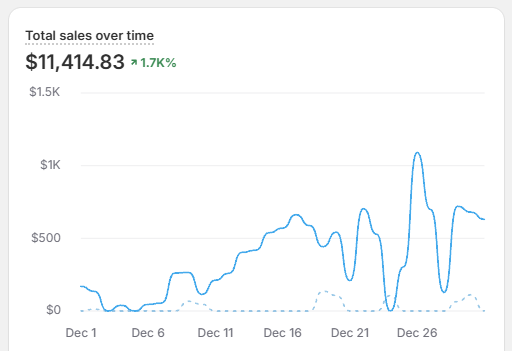
And here’s what’s interesting: all but one of those failed businesses were actually making sales.
People were buying right up until the day I shut them down.
So whatever makes a creative business not work, it’s usually not what everyone thinks it is.
The Economics Need To Make Sense
You know those satisfying packing videos where an artist is boxing up hundreds of mail club envelopes? I did the math on those.
At a $10 price point, after printing, shipping, and an entire month of making the art, some of those artists are working for less than minimum wage.
They may have hundreds of paying customers, but it’s barely enough to cover their living expenses.
And that brings me to the first boring thing: the economics of your business need to make sense.
Or, as the cool kids say, the math needs to math.
And mail clubs aren’t the only place I see this.
Sticker and accessories sellers, I’m putting y’all in the spotlight here too with love.
I constantly see amazing artists making art that I could NEVER make in my lifetime, then putting that beautiful art on stickers, keychains, and buttons.
But when you’re selling something that can’t be priced at more than a few dollars, which is the perceived value of these types of products, your margins are so slim that you need serious volume to make all that effort worthwhile.
Which means you need a LOT of marketing, traffic, and eyeballs on your shop all the time.
And the amount you’d make in a month this way is a fraction of what someone else could make selling something like charms.
Now, some people are really good at the volume game.
Or they have such a prolific art style that grabbing attention on the internet comes super easily to them, and people just flock to their work.
And if that’s you, amazing. I am SO JEALOUS.
But that’s not a model that’s easy for me to do, and it’s not something that’s easy for other people to replicate.
If you’re one person making things at your kitchen table, you want products that can command higher prices and greater profits without relying on a volume game to make a meaningful paycheck from your creativity.
That’s what the successful businesses across everything I’ve tried to launch over my 20 years have in common.
So here’s what’s actually going on there, everything in business costs money and getting people to your shop costs money.
Even if you’re vending at a local fair, there’s the booth fee, the display stands, the table decorations and your time costs money too, even though nobody sends you a bill for it.
That means the time you spend on social media might feel like it was “free,” but it’s not.
So what this means is that every product you sell needs enough profit baked in to cover all of that time, with something left over.
If it doesn’t, you can be making sales every single week and still be slowly going broke.
And this is why the price you put on your products matters way more than most people think.
It’s not just what you get paid. It’s what determines whether your business can even afford to exist in the first place.
Let me say that again: The price you put on your products is what determines whether your business can afford to exist.
It is THAT important.
Let me show you what it looks like when the math does math.
At Tiny Hands, I can make around 20 to 30 charms in a five to six hour day and my material costs are almost nothing because it’s clay, and it’s very affordable.
Each necklace costs me about $2 to make in supplies, and they sell for $30 a piece.
So one day’s worth of charms is roughly $900 in sales.
$900 for roughly $60 in supplies and a six-hour workday? That’s a $140-per-hour rate.
Not bad, right?
But that amount needs to be high because it has to pay for my time to keep working on the business even when I’m not making anything – when I’m not making charms or making sales.
I still have to do all the business-y stuff, like sending emails, doing outreach, running ads, and replying to my customers.
And the profit from my sales also pays me to go get more sales.
Because promoting your shop takes time and effort, right?
Now compare that to my T-shirt line.
I sold T-shirts under Tiny Hands. I paid an artist $500 per design, did a whole photoshoot, and then, on top of that, there were printing costs and the cost of the shirts themselves.
And I made sales on the shirts.
Just not at the volume I needed to justify continuing to sell them.
Same thing with the kits we sold at Mini Food Tutorials, a business I started and ran with a partner.
The supplies that went into the kits were expensive, and putting each kit together took a lot more time than I thought.
It took about the same amount of time it would take to actually MAKE a charm.
But here’s the kicker: a kit isn’t a finished product, so people aren’t willing to pay finished-product prices for it.
There was a hard ceiling on what we could charge, and the costs were so high that there was never enough profit to make it worthwhile.
Both products were making sales but the math just never made sense.
And the new store we have? Everything in it gets printed when someone orders it.
That’s called print on demand, so we don’t own a fancy printer or paper and ink. A company does all of that for us.
Not having to carry a lot of inventory is a huge help.
But here’s the catch with charging higher prices: total strangers will only pay them for a certain kind of product.
Researching What People Already Buy
Which brings us to the second boring thing: a product that total strangers will actually pay money for.
Now, there are three parts to this, so let’s dive a little deeper into what I mean.
First, I research what people are already buying. And my whole research process is just Google.
It’s free.
The first step is to find at least 8 to 10 other successful shops selling something similar to what you want to make.
Not just the top 2 or 3 results. I want you to dig deeper and see the full range of what’s already out there and doing well.
And note, I said “similar to what you want to make,” not necessarily “EXACTLY what you want to make.”
Also, finding competitors is a good thing.
Competition proves that people are buying what you have.
If nobody is selling anything like your idea, that usually doesn’t mean you found a huge opportunity.
Although, if you’re an experienced business owner and have the eye for this, sometimes it could mean that.
More often than not, though, it usually means there’s no demand, and you should proceed with caution.
It could be amazing, but it could also be an uphill battle for you.
The second thing is to look at their pricing.
And this is the first boring thing in action, because this research tells you whether the math can math before you’ve made a single product.
When you look at their pricing, you want to find out: What’s the range people are actually paying, and what’s the ceiling?
That ceiling tells you how much this type of product can be worth to someone, and whether there’s enough room in it for your business to afford to exist.
The third thing is to look at what all of those shops have in common.
Because whatever they all share, THAT is your opening to be different.
That’s exactly what we did with the new store.
Before we made a single product, I noticed that every seller in that market was using the same dark blue backgrounds or plain black-and-white designs. They all looked the same.
And as someone who loves color, the opportunity felt pretty obvious to me.
Let’s bring more color into this niche.
That was the same thing I did with one of my failed businesses, Jewel & Justice, where I sold colorful initial necklaces.
At the time and still to this day, this market is saturated with gold and silver options.
And they’re beautiful, but what if you want something different? Something a little more fun?
What if you love color, like me?
So that’s how I came up with the idea for Jewel & Justice, which made sales right away.
Except I ran into some issues, which ultimately resulted in me closing down the shop.
Here’s the problem I ran into, twice, actually.
When total strangers spend their hard-earned money on your products, they expect a certain level of quality, right?
And because I want to avoid language like “good” or “bad,” which can be triggering and is also so subjective, I call this commercial-level quality instead.
When someone who’s never met you pays for your product, they’re comparing it to everything else they’ve ever bought, not to something their friend made for them at home.
Commercial-level quality is the level of quality you’d expect to find in products sitting on the shelves at Target or in your favorite gift store in that cute part of town.
My initial necklaces were selling well, but the stamp I had made wasn’t detailed enough for the clay I was stamping them into, so the letters came out undefined.
If your initial was an I, your necklace kind of looked like a J and so people complained, and they were right to.
Same thing with Mini Food Tutorials.
We sold PDFs and video lessons, they sold, but we just weren’t good enough miniature artists to make the kind of tutorials people pay premium prices for.
There was a level of polish we were lacking, and I didn’t know how to get there.
I could’ve practiced more, but my heart also wasn’t in it, I didn’t set out with the goal of becoming a miniature artist.
Yes, I sell mini food jewelry, but that’s not nearly on the scale that a miniature artist would make them at, which is mind-blowing and I can’t do that.
So if your craft or your process isn’t at that commercial-ready level yet, you have two options.
You keep practicing until it gets there and you can keep selling in the meantime. This doesn’t mean you have to close down your shop.
That’s what I did with Tiny Hands, my clay charm shop that makes six figures every year.
Or you find something else you can make at that level today.
And I want to say why I believe this is SO SO important.
There are a lot of businesses selling products that look great on paper, especially with what AI can do these days, but where the product you actually get is really underwhelming or straight-up disappointing.
And the sellers don’t really care if they get one-star reviews and unhappy customers because they already got the sale.
In my opinion, that’s a recipe for a shop that will fail fast.
I’ve been in business online for 20 years, and it’s not because I’m trying to make the fastest money possible without any care about whether people love my products or not.
I was never the fastest business owner at making the most money.
But I keep my customers happy, they come back and that’s what gets you to last for 20 years to make a lifelong career out of this.
I’ve been in the game long enough to see that when you compromise on the product or your offer, those very same people end up quitting prematurely because they can’t get their business to keep working.
Getting Eyeballs On Your Work
Which brings us to the third boring thing.
The one I told you at the beginning took that store from zero to $11,414 in 30 days with no audience.
The third boring thing is traffic, because you need actual eyeballs on your work in order for sales to happen.
And I want to start with what we didn’t do, because it surprises a lot of you.
Social media content was never part of the plan for this new store.
Social media isn’t “bad”, I use it in a general way across all our businesses.
But content takes a long time to work.
You have to figure out your angles, your messaging, your hooks, what actually gets views for your specific product and audience and then you still have to build an audience one follower at a time.
That can take months and years, and it’s not what yields consistent sales, from what I’ve seen.
So instead, I leaned on the two leverage points that work so well, especially when nobody knows you exist.
And that is paid ads and influencer outreach.
Here’s the difference between them.
Paid ads cost money, and they’re fast, you can turn them on today and have strangers seeing your products tonight.
But this is exactly why the first boring thing had to come first. Ads only work when there’s enough profit in each sale to pay for them. When your math maths, ads are like an ATM where you put $1 in and get $2 back, when it doesn’t, ads just help you lose money faster.
If you want to learn how I run my paid ads, I have a Paid Ads Bootcamp where I break down the strategy step by step.
You can check out the Scroll to Sales Ads Bootcamp or the Search Ads Bootcamp. And if you want both, the Ads Bootcamp Bundle is also available.
Now, influencer or media outreach is the opposite, it costs you almost no money, but it costs you time.
You’re pitching your products to people who already have the audience you don’t have yet.
I’m talking about influencers, bloggers, publications, gift guides, magazines, even TV shows.
I used outreach in all 3 of my biggest businesses that I still run today, and even huge billion-dollar companies are using outreach and influencers as a way to promote their products.
But even if you’re a small shop just getting started, it can work so well for you.
One feature put my products in front of somebody else’s audience and made me thousands of dollars in sales from just doing a bit of research and sending out some emails.
If outreach sounds more like your kind of thing, I have a free workshop that walks you through how to get your products featured in more detail.
Go through this link: https://tinyurl.com/yc4p6emm
Now, you need one thing for any type of traffic to work: your own website.
And I’m not saying that as some philosophy about owning your platform, ’cause you guys know I harp on that plenty in other blogs.
It’s actually really practical.
If you run ads to an Etsy listing, you’re paying to send people to a page where they’ll see ten similar products from other shops right under yours.
You’re essentially buying traffic for your competitors.
And say a blogger or a gift guide features your work, but you only have your Instagram account.
You KNOW how distracting and easy it is for people to leave your profile and go watch something else, right?
You’ve worked so hard to get that person to your shop, you need to ensure they stay in your shop as long as possible.
And when you send traffic to your own site, you can do so much more to get them to stay longer.
Remember at the beginning when I said almost all of my failed businesses were making sales?
This is something I really want you to understand, Jewel & Justice was making sales when I shut it down. The T-shirts were selling, the kits were selling.
Every one of those businesses had customers, and they still didn’t work because each one was missing just one of the three boring things.
But when all three are there from day one, that’s when a brand-new store does $11,414 in its first 30 days with no audience.
Now, knowing the three things and knowing what order to do them in are two different problems.
Because tomorrow morning, what do you actually do first?
Do you research products first?
Do you build the website first?
Do you set up the ads?
I made a blog that walks you through building your online store the fast way, the whole strategy from start to finish, in order.
Just click here: https://tinyurl.com/mwnsw28e
That’s the biggest lesson I’ve learned from all of these businesses, both the ones that worked and the ones that didn’t.
You don’t need a perfect idea, a huge audience or some secret strategy nobody else knows about.
You just need to build a business that actually works from the ground up.
That might not sound very exciting, but after 20 years of doing this, I’ll take boring and sustainable over exciting and impossible to maintain any day.

Unlock a Profitable Handmade Business
in Just 12 Weeks Without Using Etsy
or Social Media



FREE WORKSHOP
This workshop is for anyone who makes and sells a handmade or physical product, including jewelry designers, artists, paper designers, bath & body product makers and more!
What You'll Discover
The #1 mistake people make with Etsy & social media that causes shops to FLOP
The secret to making it with your handmade shop so it's no longer just a hobby
How to make sales in your handmade shop with ease so you can finally get to 6-figures
TAKE ME THERE






Your email address will not be published. Required fields are marked *