


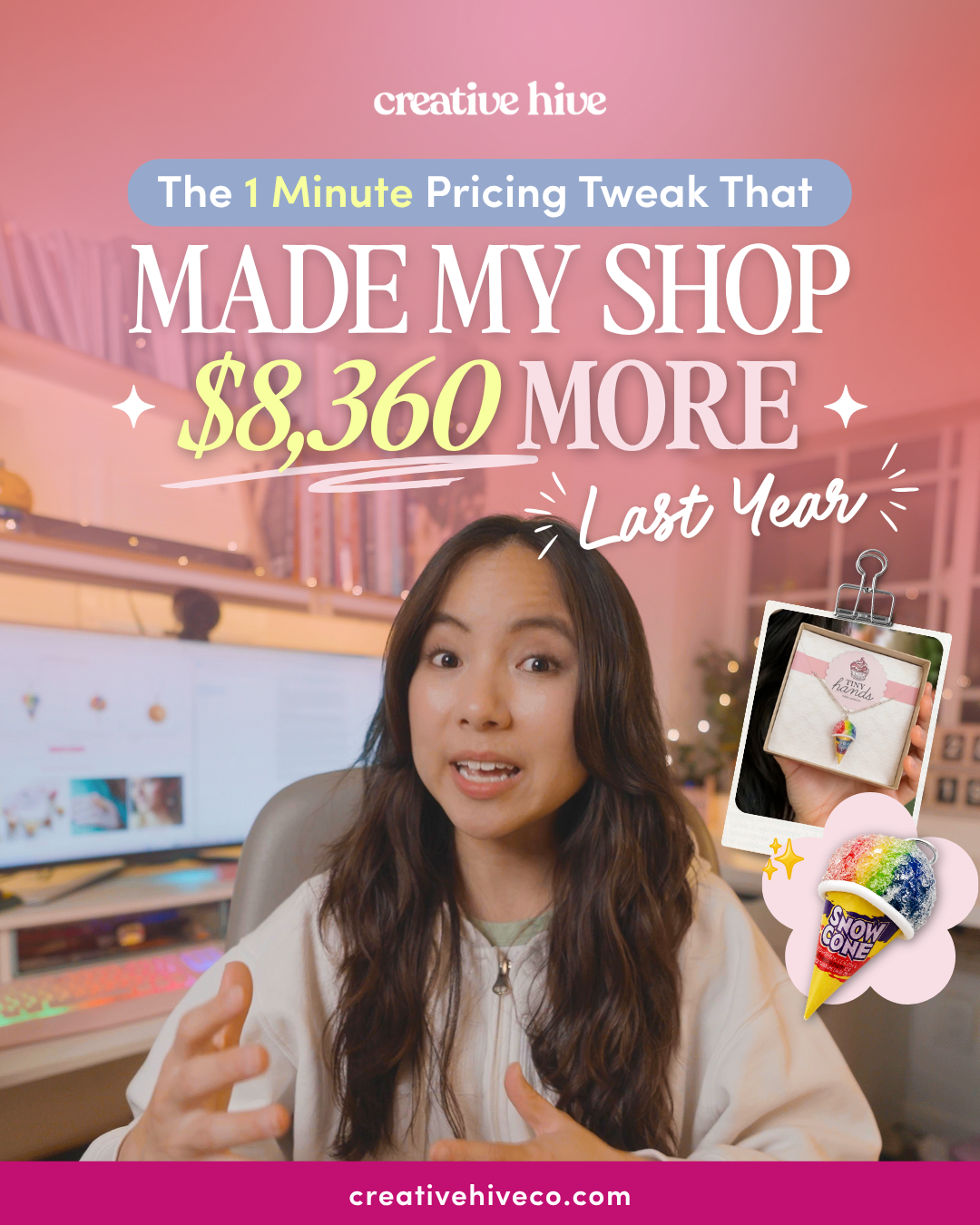
The 1 Min Pricing Tweak That Made My Shop $8,235 More Last Year





I raised the price of my bestselling product from $28 to $50, and that one-minute tweak made my shop $8,360 more than the year before from that single product alone.
So here’s what happened…
The Pricing Experiment
A couple of years ago in my Tiny Hands shop, I was selling my snow cone necklace for $28.
It was one of my bestsellers but here’s the thing: it took a bit of time to make, and at that price, it wasn’t very profitable.
So I decided to raise the price as an experiment.
I raised the price from $28 to $35 and more people bought it!
That caught me off guard a bit, so I tested it again. I bumped it from $35 to $40 and people still kept buying.
At that point, I realized something was worth exploring here. So I kept going.
Eventually, I landed at $49.99, almost double what I had originally been charging for the exact same product.
No changes, same necklace, just a different price.
Now I have a full year of data at that higher price point, which is what I want to talk about in this blog.
I went back into my Shopify reports and pulled the numbers. I compared the twelve months before I raised the price when the necklace was still $28 against the first full twelve months at $50, once everything had settled into that new price.
And what I found was… really interesting.
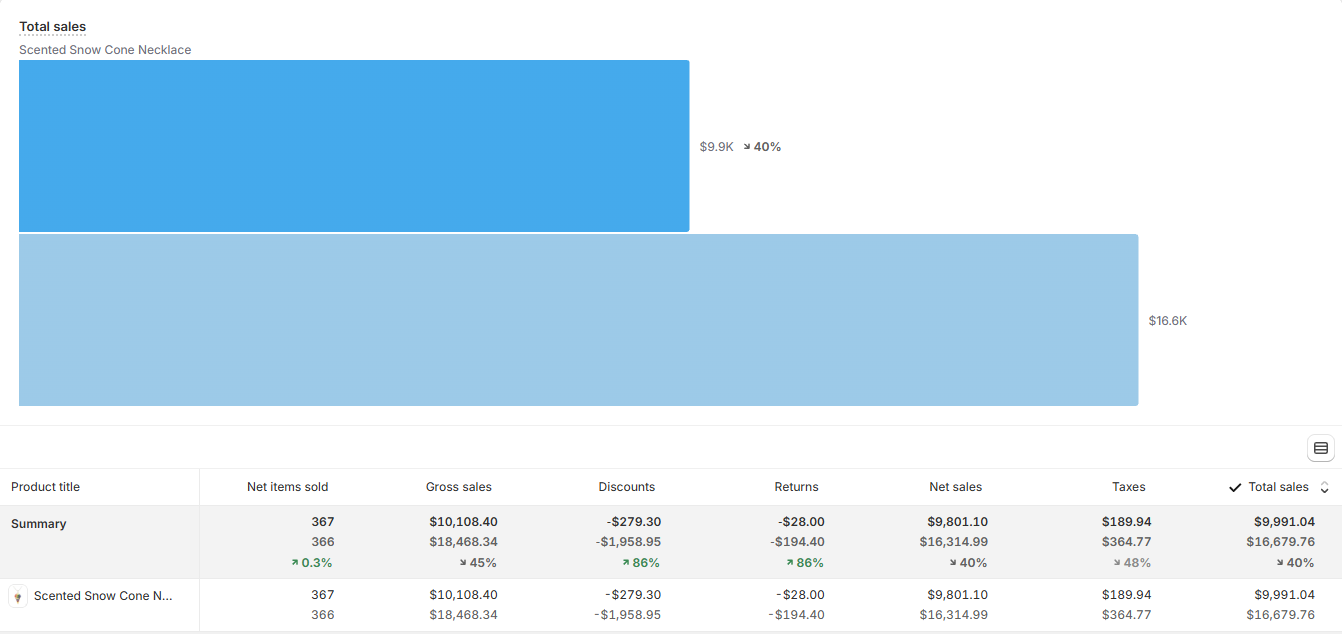
At $28, that necklace brought in about $10,108 in revenue for the year. At $50, the exact same product made $18,468.
That’s an extra $8,360 over the year from one product or about $696 more every single month on average.
That’s an 83% increase in revenue from a $22 price change and basically no extra work.
I didn’t post more on social media, send more emails or even make more charms.
Why does this work?
Now, a lot of people hear that story and they think, “Great for you Mei, but how do I know it’ll work for me?”
Or they try raising their prices, see sales dip a little, and immediately drop them back down.
But here’s what I’ve learned, this doesn’t get talked about enough in maker business advice: Raising your prices on its own isn’t the strategy.
When something looks like it belongs at $50, people don’t question the $50 price tag.
But when it looks like a $10 product being sold for $50, that’s when resistance shows up.
And the biggest factor behind perceived value, the one most shop owners don’t invest in enough is TRUST.
So for the rest of this blog, I’m going to walk you through the trust signals that actually support higher pricing.
Once those are in place, raising your prices won’t feel risky, and growing your sales is almost automatic
The problem in the maker world
I know for a lot of you, hearing “double your prices” immediately brings up some fear.
Charging more can feel really uncomfortable especially when you’re a maker who knows exactly how much your materials cost and how long each piece takes to make.
And the default assumption a lot of us carry goes something like this…
“If I raise my prices, my existing customers will feel betrayed. New customers will think I’m being greedy or they just won’t be able to afford it.”
And the whole thing is going to backfire.
But what I’ve learned, the hard way, is that the bigger problem in the maker world isn’t that we’re charging too much. It’s that so many people are consistently, chronically charging too little. And the effects of that are so much worse.
When you price a high-quality handmade product too low, it doesn’t automatically make it more appealing, it actually raises questions.
Your customer’s brain starts throwing up little red flags:
“Wait… why is this so cheap?”
“Is something wrong with it?”
“Is the quality not what the photos suggest?”
“Is this shop even legit?”
When a product looks premium but is priced unusually low, it creates a mismatch, a kind of cognitive dissonance that makes people hesitate instead of buy.
And then there’s the part most people don’t talk about enough: chronic undercharging burns you out.
You end up making more pieces for less money, the work starts to feel heavier and what used to be fun turns into something you have to push through.
And over time, the business you were excited about starts to feel like a grind.
That’s why pricing your products appropriately isn’t optional, it’s necessary if you want to actually sustain your business.
And for most of us, that means raising our prices.
Branding that matches your price point
To make that work, you need to build trust signals around your business and the first one I want to talk about is probably the biggest offender I see.
It’s the thing customers react to before they’ve consciously looked at anything else in your shop.
Most shoppers can’t even explain what they’re noticing but within the first half-second of landing on your page, they’ve already decided whether your price feels justified or not.
It all comes down to this: does your overall branding feel like it belongs at the price you’re charging?
This is where a lot of makers get stuck. They have beautiful products and they’ve taken decent photos.
But the logo? It was something they threw together quickly years ago.
The shop’s overall aesthetic doesn’t quite match it, the colors and fonts feel disconnected like they’re not telling the same story.
And customers pick up on that instantly, even if they can’t put it into words, they feel it, it happens on a subconscious level.
And that split-second impression plays a huge role in whether they take your pricing seriously or not.
It’s also what helps you stand out from competitors but that’s a whole other conversation.
Branding matters a lot but this is the part most makers struggle with.
Not because they don’t care, but because they’re not branding experts, they’re not comfortable with graphic design tools.
Even hiring a professional can cost thousands, which just isn’t realistic when you’re starting out.
If you’ve been following me for a while, you already know I’m a big believer in DIY-ing a lot of things in business.
And yes, a professional branding expert can absolutely be worth it but if you’re just starting and don’t have the budget yet, you can still do this yourself and do it really well.
Well enough to build that trust your customers are looking for.
And when I say “really well,” I don’t mean perfect or high-end agency-level branding.
I mean something that feels professional and aligned with what you sell, something that clearly reflects your product or your vision.
That’s the goal, not bespoke perfection. Just clarity, consistency, and a brand that feels like it belongs.
To put it into perspective, even after 20 years in business, I’ve never paid a professional branding expert for any of my physical product stores and I’ve made millions selling products online over the years.
So how do you actually do this well?
That brings me to today’s sponsor, Design.com.
It’s an AI design platform built specifically for small business owners who want a cohesive, professional-looking brand without needing to hire a designer.
And I know, in the creative space, AI use is sketchy and questionable.
But Design.com ‘s AI is trained specifically to ensure originality and copyright safety, so rest assured, your logos aren’t going to be rip offs from existing artists’ work.
What stands out to me is that it’s not just a logo generator, it’s an end-to-end AI branding system.
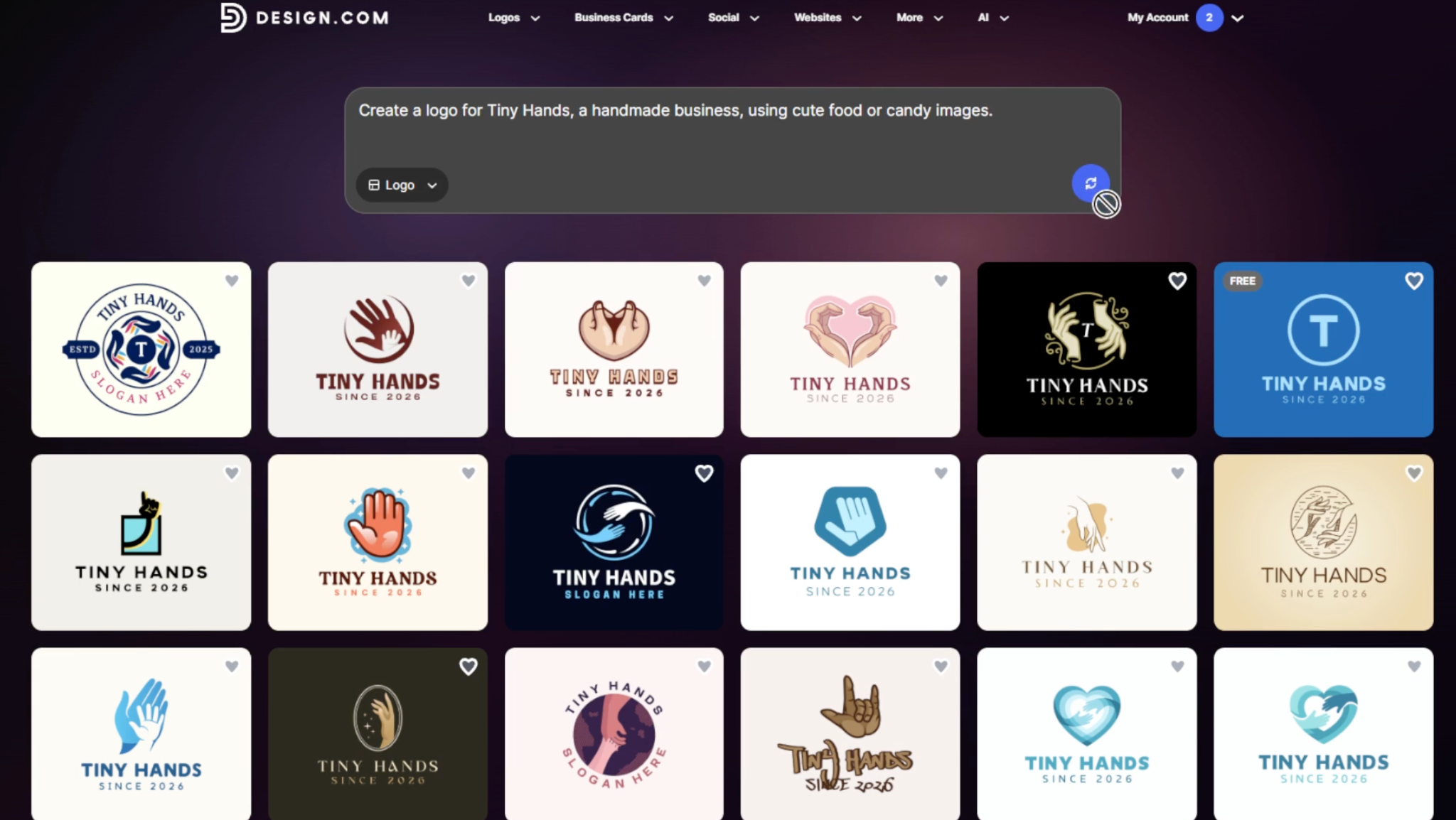
You simply enter your business name and a few keywords.
For makers, I’d recommend using product-specific keywords like your actual product category, such as “jewelry” or “ceramics” rather than vague style words like “simple” or “whimsical.”
Then the AI generates original logo options for you to choose from.
Once you pick one, your brand colors automatically carry through the rest of their design tools.
So your business cards, social media posts, thank-you inserts, website, or link-in-bio page all magically match.
That consistency and cohesiveness are powerful trust signals.
I’ve seen a lot of shops struggle with this part, so it’s definitely something to watch out for.
If you use Design.com, they handle all of this for you automatically.
You can use your designs anywhere your shop’s brand shows up on products, packaging, business cards, and more.
You can start for free to see what their AI generates for your specific business.
So if you need to create your branding or upgrade what you already have, the link is here if you want to check it out: https://go.design.com/wwvq3ea
Product photos
The second trust signal is where your customers spend the most time in your shop which also means it’s where doubts tend to creep in if something feels off.
Your product photos.
And this is where I want to clear something up right away. You do not need a professional studio setup or thousands of dollars in camera gear to get this right.
Most of what actually improves your photos is free. It really comes down to the basics:
- Good, natural lighting.
- A clean, simple background so your product stands out.
- A few different angles so people can see the details.
- And at least one photo that shows scale like someone holding the necklace, or placing it next to something familiar like a coin or a ring.
Because here’s what’s happening on the customer side. They can’t pick up your product, they can’t see it in real life, so the only way they understand what they’re getting is through your photos.
If those photos feel unclear, too dark, or don’t show size properly, their brain starts trying to fill in the gaps and that’s usually where doubt starts to sneak in.
And once doubt is there, it makes it a lot harder for someone to hit “buy” especially at higher price points.
I know photos can feel like a bit of a task but once you figure out a simple setup that works, you can get it all done in a weekend and be set for a long time.
That’s why I think of product photos as business assets.
You do the work once, and they keep working for you over and over again.
They’re not just “nice to have”, they’re one of those things that quietly carry your business in the background for years.
Clear listing copy
Number three is the one that quietly kills sales because it doesn’t happen when someone is casually browsing.
It happens when they’re already on your product page, credit card basically in hand, ready to buy and then one small question pops up that you didn’t answer.
And they leave, no message, no follow-up at all, just gone.
You never see those lost sales in your inbox, which is exactly what makes this one so expensive.
It all comes down to your listing copy.
Things like, what the product is made of, the exact dimensions, how long shipping takes, and what happens if it arrives damaged.
These are the questions running through a customer’s mind when they’re about to spend $50 on something from a shop they’ve never ordered from before.
If your listing doesn’t answer them, one of two things happens…
They message you (which slows everything down and still loses the people who don’t bother asking), or they just leave.
So the fix is simple, be specific.
List your materials, list your dimensions clearly and include realistic shipping times, not vague promises.
And if your product has details that matter, say them out loud, like if a handbag has multiple compartments inside, don’t assume people will notice that, call it out or notice it in your photos.
Every question you answer in your listing is one less reason for someone to hesitate.
And ideally, your photos are doing the same job too so by the time someone reaches the “buy” button, there’s nothing left for them to wonder about.
Address objections proactively
The fourth one is something I really wish someone had told me earlier in my business, because I lost sales for years without even realizing it.
It’s about the objections shoppers have about your product.
These are the fears and hesitations that never make it to your inbox which means you don’t even know they exist, even though they’re costing you money every single week.
For handmade products, I see the same ones come up again and again:
Is it durable? What if it arrives broken? How long is the real shipping timeline? Is it actually solid gold?
And the thing is you already know what your customers are worried about because you’ve answered these questions a dozen times before in DMs, emails, craft markets and pop-ups.
So the answers are already there, they just need to be placed where new customers can actually see them.
Put them directly in your product listing, or in a pinned FAQ section.
Because the customer who would never think to ask is usually the one who needs that reassurance the most.
And when those objections are answered upfront, people don’t feel like they need to double-check or hesitate, they just feel ready to buy.
Easy support
Here’s one that surprised me when I started paying attention to it.
A lot of your trust signals actually work on shoppers who never end up using them at all and the next trust signal is probably the biggest one in that category.
It’s your support setup.
An easy-to-find contact link, a clear response time (something like “I reply within 1–2 business days” works perfectly), an FAQ page, maybe even a phone number if you take calls.
Honestly, because I’m an introvert and don’t love taking calls, I do have a phone number but people rarely call in the first place.
And when they do, it usually goes to voicemail, and we just follow up over email anyway.
But here’s the point, all of these things work as trust signals, even for customers who never actually use them.
Because visible support changes how your shop feels, it tells people that if something goes wrong, there’s a real person on the other side who will actually help them.
And that alone makes people a lot more comfortable clicking “buy now.”
Social proof, even small
And number six is the one that trips up newer shop owners the most.
Because there’s a common misunderstanding about what this actually means in practice and the discouragement that comes from that misunderstanding is what keeps a lot of makers stuck at lower price points for years longer than they need to be.
It’s social proof.
People think social proof means thousands of five-star reviews, and because they don’t have that yet, they assume they’re not “ready.”
But real social proof can be so much smaller and simpler than that.
It can be just a handful of reviews on your shop, a customer DMs sharing how much they love their piece.
It can be testimonials from custom order clients you’ve already worked with, can even be friends or family who’ve bought from you and can give you a short, honest quote about the product.
The point isn’t volume, it’s evidence that someone other than you has said, “this is good.”
A shop with six thoughtful reviews will outsell the same shop with zero reviews every single time.
And I know a lot of you are tired.
Tired of being told to just post more reels, of Etsy SEO being pushed as the answer to everything or that lowering your prices will somehow fix the problem.
You can already feel when those things aren’t working for your shop, usually in the form of very few sales, despite all the effort going in.
What you actually need isn’t more generic advice, it’s a clearer strategy for your specific shop.
Something that looks at what you already have, your products, your pricing, your photos, your shop data and tells you the few things that will actually move sales forward this week.
That’s what I built with the Shop Operator.
Each week, it reviews your shop and gives you 3–5 specific actions to focus on, ranked by what’s most likely to impact your sales first, with the reasoning behind each one.
So instead of guessing what to fix next, you know exactly where to start.
If you want to stop cycling through advice that doesn’t fit your shop, just go through this link: https://bit.ly/4cWLhAn
You can get your custom sales strategy in just a couple of minutes!
And if you’re looking at your shop right now thinking there are a hundred things you should fix before raising your prices, I get that.
But the order you do things matters more than most people realize.
And that’s exactly what this blog breaks down because doing the right things in the wrong order is one of the easiest ways to lose money without even noticing.
Head to this link to read it: https://tinyurl.com/4dxfuaad
At the end of the day, that one minute pricing tweak worked because it wasn’t just a number change, it was a trust check.
When your product and your shop are already doing the work to build confidence, a higher price doesn’t need to be justified or forced, it just fits.
So the real shift isn’t about doing more, it’s about making sure every part of your shop is quietly building trust instead of leaving gaps for hesitation.

Unlock a Profitable Handmade Business
in Just 12 Weeks Without Using Etsy
or Social Media



FREE WORKSHOP
This workshop is for anyone who makes and sells a handmade or physical product, including jewelry designers, artists, paper designers, bath & body product makers and more!
What You'll Discover
The #1 mistake people make with Etsy & social media that causes shops to FLOP
The secret to making it with your handmade shop so it's no longer just a hobby
How to make sales in your handmade shop with ease so you can finally get to 6-figures
TAKE ME THERE
Your email address will not be published. Required fields are marked *






I really resonated with your insights on the pricing tweak! I made a similar adjustment in my shop last year and saw a noticeable increase in sales too. It’s amazing how just small changes can lead to big results. Checking out tools like driving directions for driving traffic has also helped me maximize those sales. Appreciate you sharing your experience!
That price hike experiment is a perfect example of how even tiny tweaks can have massive ROI. Similarly, with the right free AI tools, a few minutes of setup can save hours each week—I’ve been using directories like free ai list to quickly find ones that actually deliver on their free tier promises.
We are delighted to welcome you to Subway Surfersgames for free, the premier platform for the ultimate unblocked subway surfer experience. You have arrived at the appropriate location if you are fond of speed, exhilaration, and endless running. Our website is intended to deliver the full experience of Subway Surfers, one of the most popular endless runner games in the world, directly to your browser.
You don’t know what free online games to play, give this gaming platform a try. With hundreds of games, it offers a smooth and fun gaming experience to players. True.