


How I’d Make My First $1000/Month Selling Handmade in 30 Days




I have six- and seven-figure physical product businesses, and I’m going to show you exactly how I’d make my first $1,000 a month selling handmade in the next 30 days so you can copy what I do.
If you’ve been putting in the work but the sales still aren’t there, it can start to feel like maybe this just isn’t going to happen for you.
I’ll walk you through exactly what I’d do from day one, what I’d skip, what I’d prioritize, and the one thing I did in my first week that most makers don’t figure out for years, if they ever figure it out at all.
The Real Bottleneck why making sales is hard
The bottleneck you think is keeping you stuck isn’t actually the bottleneck.
The secret to finally starting your business is to shorten the amount of time it takes to figure out what sells for you.
That’s the real goal because the thing you think is holding you back probably isn’t what’s actually holding you back.
I think a lot of people are afraid to start their business because they don’t feel like their product is ready yet.
Or maybe you worry that you’re not talented or skilled enough at what you do, so you think… “Why would anyone pay for my work?”
Your product being good enough, or you being good enough, actually has nothing to do with how much money you can make selling your work online.
Those fears come from the belief that we live in a meritocracy.
We think that if we work hard enough, or if our product is good enough, we’ll eventually be rewarded.
But after 20 years as a self-employed maker, I can tell you that simply isn’t true.
Realizing that was one of the biggest lightbulb moments of my life.
So while the things you think are keeping you stuck are real and completely valid, they aren’t actually the things you need to figure out if you want to start selling more of your products.
The real bottleneck is not knowing what you can make that people will actually buy.
So in this blog, I’m going to share a few ways to figure that out so you’ll know exactly what direction to go in.

The First Thing to Figure Out
When I started my very first business, Tiny Hands, it took me six years of making all kinds of things before I finally landed on food charms.
I made journals, beaded jewelry, pencil cases, all kinds of polymer clay charms, and so much more. It was a lot of trial and error.
I also started several businesses that didn’t work out before I eventually launched a map art shop that made over $1,000 in its first month.
With that new store, I knew what people wanted to buy within the first two weeks of launching.
And I want you to pay attention to that timeline.
I didn’t have some crystal ball telling me what would sell so my shop would be a huge success on day one. I only found out after I launched.
I think we spend so much time worrying that we need all the right answers before we do anything scary. But this is proof that you don’t.
Instead, we overthink everything, make it much harder than it needs to be, and then never launch, even after spending years dreaming about owning a shop one day.
The first thing that makes this whole process so much easier is getting crystal clear on who you’re making your products for.
Most of us start with the product. We make what we love, what we’re good at, and what excites us then we assume that if we love it, someone out there will love it too.
And that’s not wrong.
But when you don’t pair that with a really clear picture of who you’re making it for, you end up with a shop that feels scattered. Sales come in randomly, and you never really know why something works or why it doesn’t.
For a long time with Tiny Hands, I thought I was making products for people who like cute things.
The problem is that “people who like cute things” describes almost everyone, which means it doesn’t really describe anyone.
And I had no step-by-step, tangible way for how to find “people who like cute things”.
Not only was it too broad, but it was too vague.
With my map art shop, I knew before I listed a single product exactly who I wanted to make things for.
I wanted to create meaningful, personalized art for families.
People celebrating a new home, an anniversary, or a place that meant something special to them.
Having that clarity made every decision so much easier.
It helped me decide what to make, how to describe it, who to reach, and what occasions I wanted my products to be part of.
When you know exactly who you’re making products for, every decision becomes easier. Instead of guessing what might sell, you’re simply answering what one specific person needs from you.
That is a completely different and much easier way to build a shop.
Here’s how you can tell if you’ve done this well.
If you feel activated, like you know exactly where to go and what to do to find your customer online, then you’ve probably nailed it.
So think about who your person really is, and I mean specifically, not “people who appreciate handmade things.”
- What are they passionate about?
- What gets them so excited that they’re willing to spend their disposable income on it?
- What communities or groups do you already belong to that you could create products for because you’re already your own customer?
- What styles, designs, or interests do you already understand because you’re part of that world?
The more specific your answer is, the easier everything that comes next becomes.
Once you know who you’re making products for, the next question is what you’re actually going to put in front of them.
Choosing what products to create
This is where most people completely overthink it.
Most makers think they need dozens of designs and product listings before they can start making money.
But that’s not true.
When I started my map art shop, I didn’t launch with 50 products, I launched with just six listings, and every single one was built for the same customer. That’s what made it work.
So here’s what a small product range can actually look like, fewer than 10 listings, all created for the same person, with a few different price points.
Not a little bit of everything you know how to make, you can expand over time, but that’s not what you need when you’re just getting started.
In fact, most businesses make 80% of their sales from just 20% of their products.
That means you need a lot fewer products than you probably think.
I really struggled with this when I first started Tiny Hands because I didn’t have a clear customer or a clear identity.
And that showed in the products I was making, that’s one of the reasons that shop was so much harder to grow.
With my map art shop, everything was colorful, fun, and personalized.
We offered different styles, but everything felt cohesive, there was a clear thread connecting every product.
That thread is what I call your special sauce.
It’s the thing that makes your version of that product instantly recognizable as yours, for my map art shop, it was color.
At the time, most of the personalized map art on the market was muted and traditional, there’s absolutely nothing wrong with that.
It’s beautiful but I love color.
There weren’t many people creating bright, colorful personalized maps, so that’s exactly what I made.
I designed everything to feel bright, fun, and eclectic, and that one decision helped us stand out right away.
Your special sauce doesn’t have to be complicated. It could be your packaging, your color palette, a material no one else is using, or the feeling your work creates.
But it does need to be specific and it needs to be opinionated.
Simply making good handmade products or having beautiful work isn’t enough to make people remember you.
Once you’ve figured out your product line and your special sauce, the next step is creating a visual identity that reflects both of them.
This is what brings everything together and communicates everything we’ve been talking about.
Your logo, your shop banner, your social media graphics, and your product photos should all feel like they’re part of the same brand.
And if you’ve ever tried putting all of that together yourself, you already know it can take months.
That’s where Design.com comes in. It makes it easy to create professional-quality branding for your business
All you have to do is type in your business name and a few keywords, and Design.com generates logo options for you in just a few seconds.
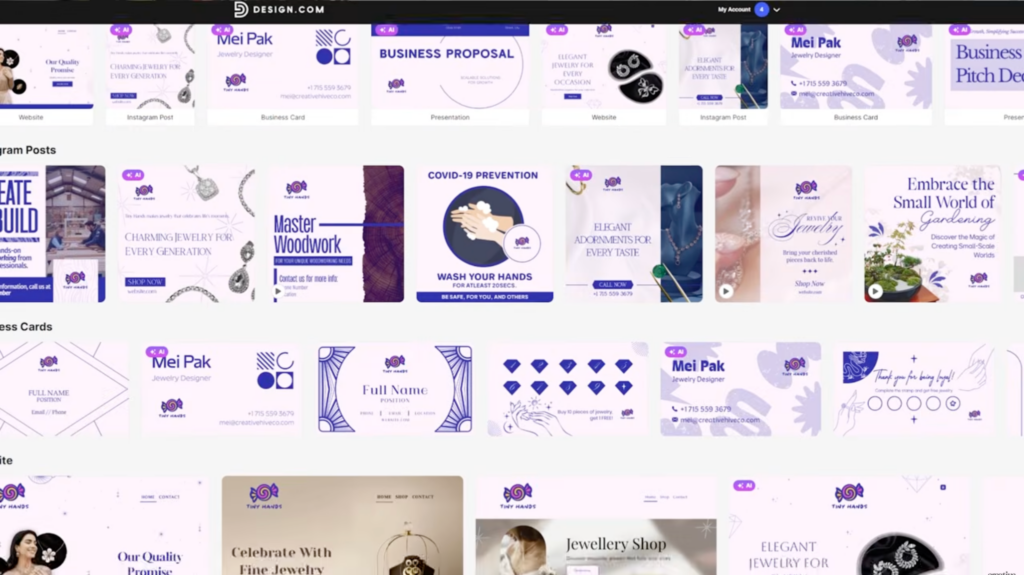
Once you’ve chosen a logo, you can use that same style to create your social media graphics, shop banners, and everything else you need, all in one place.
It’s incredibly easy to use, and you don’t have to learn complicated design software to create great branding for your new business.
Everything you create with Design.com has a professional, consistent look.
So when someone finds you on Instagram and then visits your shop, it all feels like the same brand.
That consistency builds trust, and people are more likely to buy from a business that looks polished and cohesive.
That’s something a lot of new shops are missing.
If you’re interested, you can sign up for a free Design.com trial here: https://go.design.com/wwvq3ea
Getting Your Products Seen
Starting a business from scratch doesn’t mean you have to build an audience before you can make sales.
You can borrow one instead.
That’s exactly what I did with my map art shop, and it’s a huge reason why it became successful so quickly.
We made over $1,000 in the first month, and it happened with so much more ease than my first business.
Here’s what I mean. During the first week after launching my shop, I was already getting traffic without having an audience of my own.
Instead, I reached out to influencers whose audiences overlapped with my ideal customer, and I ran paid ads to get in front of people who were already looking for what I was selling.
I didn’t wait until I had built a following.
I borrowed audiences that other people had already spent years building, so I didn’t have to.
That gave me real data on which products people were actually drawn to, without me spending months or years trying to grow my own audience first.
Once I knew which products were working, I leaned into them.
The faster you get real data about what’s working, the faster you can do more of it. That speed is a huge part of building a successful business.
It’s something I had to figure out on my own and it’s one of the biggest things I want to share with you today.
Now, there are a few ways you can do this yourself, depending on where you are in your business.
If you’re just getting started, craft shows are a great option.
You’re showing up where people are already shopping, you don’t need an audience, and you get real-time feedback on what people are interested in.
Influencer marketing is another great option.
Find creators whose audiences already overlap with your ideal customer and get your products in front of them.
If you want me to walk you through exactly how to do that, I have a free workshop that covers the entire process step by step. You’ll find the link in the description.
Paid ads are another option.
Once you have a few products and a basic shop set up, which honestly is something most of us overthink because it really can be done in about two weeks, you can start putting targeted ads in front of people who are already looking for products like yours.
You don’t have to post every day or spend months growing a social media account first.
You can start getting data, and even sales, on the very first day you turn your ads on.
Now, of course, there’s one big asterisk. You do need to learn how to run ads properly because it’s very easy to waste money if you don’t.
But all three of these strategies do the same thing.
They get your products in front of real buyers before you’ve built much of anything, which means you find out what people are actually willing to buy from you a whole lot sooner.
Timing Launch for Sales
Now, here’s another thing I’d recommend because it was a huge part of how I was able to get data and sales more quickly.
The timing of when you launch can make a huge difference in your momentum.
Most makers launch when they feel ready.
Which usually means either never, three years from now or whenever they finally feel like the timing is right.
And I completely understand that, building up to a launch is scary and when you finally feel ready, you just want to go.
But here’s the thing, when you feel ready and when your customers are ready to buy can be two completely different timelines.
With the map art shop, I didn’t just launch when I had enough products.
I gave myself a real deadline and I launched when my customers were already in buying mode.
That was during the holidays in Q4.
October and November are great times to launch because people are already out searching for exactly what you’re selling.
In fact, I launched a third store, The Bright Jewel, during the holidays as well and I started making sales right away even though it was a brand-new shop.
When you launch into existing demand, you don’t have to create that demand or convince people to buy.
You just have to show up and that makes everything easier.
It makes getting data easier and faster because you’re able to see what people respond to while they’re already in the mindset of purchasing.
That creates the feedback loop you need to improve and grow your business, which can be much harder to build if you launch during a time when people simply aren’t shopping.
If you’re thinking about starting your business and there’s a major buying season coming up soon, it can be worth giving yourself that good kind of pressure to get things moving so you can ride that wave.
Q4 is coming soon, so maybe take this as your sign to finally get your shop off the ground.
The handmade gift category has three major shopping windows.
The first is Q4, which runs from October through the middle of December and is by far the biggest shopping season.
Then you have Mother’s Day and Valentine’s Day.
Of course, your own product might have a different peak season. For example, if you create wedding-related products, summer wedding season might be your biggest opportunity.
So always think about your specific customer and your specific product when deciding when to launch.
Double Down on What’s Working
Once I had some data from the map art shop, I could finally see what was actually selling.
Instead of adding more products, testing random ideas, or just guessing what might work next, I leaned into what was already working.
And as a creative person, there’s definitely an urge to fight that.
Because making new things is exciting, it’s easy to convince yourself that the next idea might be the one that does even better.
But the products that were selling were selling for a reason.
Your job at this point is to figure out what that reason is and do more of that.
A lot of the time, that means creating variations of the same style or concept that was already working well.
With Tiny Hands, I kept chasing the next big thing.
Not only was that exhausting and time-consuming, but the number of times I created something that completely flopped was much higher than when I simply followed the data and listened to what people were already telling me they wanted.
And I really think that’s a big reason why growing Tiny Hands took so many years.
A lot of building a business as a maker is both art and science.
It’s both creativity and business.
And when you’re growing your product line or deciding what new item to make, you need to bring in more business strategy because that’s the commercial side of what you’re building.
So if you’ve been at it for a while and things feel scattered, ask yourself honestly: have you sold anything at all?
Because if you have, even if it’s just a little bit, that’s your starting point.
Pay close attention to that, analyze it then build your next products from there.
And if you haven’t sold anything yet, that’s okay, that’s exactly what everything else in this blog is about.
Getting you to that first piece of data.
And your next question is probably going to be: how do you keep doing this and continue growing from here?
Especially, how do you build a business that isn’t completely dependent on the algorithm?
I made a blog about exactly that.
It’s how I built a $168k per year business selling charms for 10 years straight without ever going viral, and it covers the six things that kept my income consistent through all of it.
So go read it next here: https://tinyurl.com/m2tcjas7
Building a business as a maker is a journey of learning, adjusting and getting closer to what makes your work stand out.
There will always be new things to figure out, but the businesses that grow are the ones that keep moving forward, paying attention, and making intentional decisions along the way.
So if you’ve been waiting for the perfect moment to start, let this be your reminder that you don’t need everything figured out before you begin.
The clarity comes from taking action and every step you take gives you more information to build from.
Your first version doesn’t have to be your final version. It just has to be the version that gets you started.

Unlock a Profitable Handmade Business
in Just 12 Weeks Without Using Etsy
or Social Media



FREE WORKSHOP
This workshop is for anyone who makes and sells a handmade or physical product, including jewelry designers, artists, paper designers, bath & body product makers and more!
What You'll Discover
The #1 mistake people make with Etsy & social media that causes shops to FLOP
The secret to making it with your handmade shop so it's no longer just a hobby
How to make sales in your handmade shop with ease so you can finally get to 6-figures
TAKE ME THERE






Your email address will not be published. Required fields are marked *