


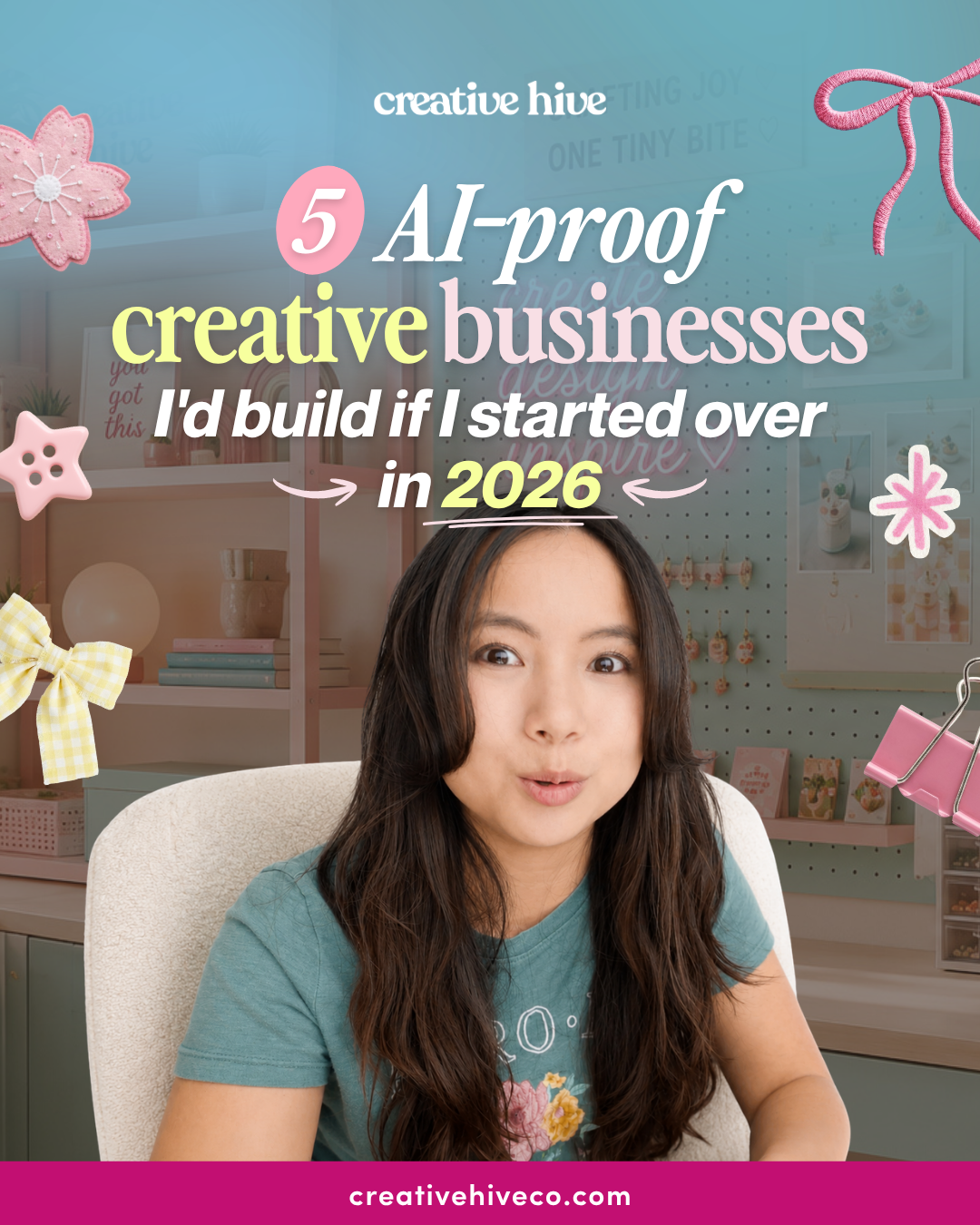
5 AI-proof creative businesses I’d build if I started over in 2026




Here are 5 AI-proof creative businesses I’d build if I had to start over in 2026. These are businesses that are genuinely hard for AI to copy or replace.
AI has already taken over a lot of creative jobs.
So if you want a business that actually has a chance of surviving through the AI wave, pay attention to this.
The first one? You could literally start it today at your kitchen table with around $15 worth of materials.
I made six figures selling this last year.
Polymer Clay Sculptures or Wearables
This was actually the very first business I ever started, and I still run it today through my brand, Tiny Hands.
You can make tiny food out of polymer clay and turn them into necklaces, earrings, magnets, charms, or cute little art sculptures.
Right now, AI thrives in the digital space.
That’s why people selling digital products are getting hit the hardest.
Things like Canva templates, print-on-demand art, and other easy-to-generate digital products can be replicated by AI so quickly now.
Personally, those aren’t the types of businesses I’d invest in starting anymore.
But sculpting something by hand out of clay? That’s a completely different story.
AI can generate an image of a cute charm, sure, but it can’t physically sculpt it for you.
And because of how flooded the internet is becoming with AI-generated content, more people are craving things that feel genuinely handmade and human.
That’s exactly why this market is bigger than most people realize.
I’ve consistently made six figures in revenue every year with my charms business.
Right now, there are creators with only a few thousand followers pulling hundreds of thousands of views on TikTok and Instagram Reels just by posting polymer clay food magnets, tiny character barrettes, and basically anything tiny and cute made from clay.
The startup cost is also ridiculously low.
You can grab three or four blocks of polymer clay from Michaels for around fifteen bucks.
Use tools you already have at home like toothpicks or a blade, and bake everything in your kitchen oven.
Most major polymer clay brands are non-toxic, even though a lot of people assume otherwise.
I’ve worked with polymer clay for 20 years and have done plenty of research on it, but if you still feel uncomfortable using your kitchen oven, you can always grab a dedicated toaster oven for around $20–30.
That’s honestly all you need to get started, you could easily sculpt 10 to 20 pieces in a single afternoon.
And in my opinion, polymer clay is one of the easiest crafts to learn that still creates products people are genuinely willing to pay real money for.

Reworked and Upcycled Clothing Using Thrifted Materials
The second AI-proof business I’d start is reworked or upcycled clothing and bags made from thrifted or donated materials.
I’m talking about things like patchwork denim jackets stitched together from three different jackets into one piece nobody else on Earth owns.
Reworked vintage tees that get cropped, painted, embroidered, or embellished.
Tote bags made from old curtains, crossbody bags made from heritage textiles.
Quilted tops made from your grandmother’s actual fabric.
This kind of work is so cool and this business is both AI-proof and POD-proof at the same time.
Why?
Because mass production depends on standardized materials, every piece of fabric entering a factory has to be identical so machines can reproduce the same product over and over again.
But once you start working with scraps, thrift bins, donated jeans, vintage scarves, and one-off fabrics, the materials themselves become impossible to standardize.
That non-uniformity becomes your moat, your competitive advantage.
As everything online turns into AI-generated this and AI-generated that, truly one-of-a-kind products are only going to become more valuable.
And we already have proof this works at scale.
I follow a textile artist who creates beautiful upcycled sweaters, and every time she launches a new collection, it sells out within minutes.
Her pieces go for hundreds of dollars each and she’s not some rare exception either.
There are creators selling out one-of-one drops every single week.
If you already own a sewing machine, you could literally make your first product today.
Go through the leftover bins at your local thrift store.
Ask friends if they have old clothes they’d be willing to donate. It’s affordable, creative, and honestly really fun to experiment with.
I think the biggest key to making this work is staying connected to current fashion trends while still creating something original.
Mixed-Media Art Using Real Nature
The third business is mixed-media art using actual elements from nature in the final piece.
I’m talking about beach stones, sea glass, dried flowers, pressed leaves, twigs, driftwood, sand from specific locations, small shells, anything you can ethically forage and incorporate into wall art, sculptures, hanging mobiles, or even jewelry.
This one is AI-proof for pretty obvious reasons.
The product itself is nearly impossible to replicate because the materials are literally unique, especially the originals.
Now, if you’re creating nature-inspired wall art and simply turning it into prints afterward, that becomes much easier for AI to imitate.
That’s something worth thinking about but the real opportunity here is specificity.
Your moat isn’t just “nature art”, that market is already saturated.
Your moat is the place the materials came from.
Pacific Northwest beach stone art, wildflowers pressed from a Vermont meadow or lake superior driftwood pieces.
People don’t pay premium prices for generic products. They pay because the piece came from somewhere meaningful, a beach they visited, a trail they hiked, a place they got married. The location becomes part of the story.
And AI can’t go to a specific beach and collect materials from it.
One of the highest-ticket versions of this idea is preserved wedding bouquet art.
Brides regularly pay several hundred dollars to have their bouquets preserved inside framed botanical pieces or resin artwork.
But here’s the important part most handmade sellers miss: you can create an incredible handmade product and still not make money from it, the product alone isn’t enough, you need a story behind it.
In business, that’s your brand.
Your brand is what makes someone scrolling online stop immediately, recognize your work as yours, and trust it enough to buy.
Without that, you’re just another handmade Etsy shop competing on price, you become a commodity.
And one of the best examples of this is Liquid Death.
It’s literally canned water, yet the company was valued at over a billion dollars in 2024.
People aren’t paying premium prices because the water itself is radically different.
They’re buying into the branding, the death-metal aesthetic, the “murder your thirst” tagline, the anti-corporate punk vibe.
That’s the real product, the story is what makes people care.
Having a great handmade product only works if you also have a strong story and brand behind it. And that’s exactly what Design.com helps you create.
If the handmade product is the moat, then the brand story is the megaphone.

Design.com is an all-in-one AI design platform that helps build your entire brand identity for you.
And yes, I know it sounds a little ironic talking about AI while discussing AI-proof businesses, but this is actually the type of AI I think makes sense to use.
Not for creating the product itself, but for helping with all the business-related tasks around it so you can start selling faster.
You type in your business name along with a few keywords, and the AI generates professional logo concepts that are commercially safe to use.
You can even customize your logo further by chatting directly with the AI and making adjustments until it feels like your brand.
The platform also creates your business cards, packaging, social media posts, and other marketing materials.
It automatically pulls your fonts and brand colors across everything so your branding stays cohesive.
And the best part is you don’t need design or tech skills to make it look good.
You just describe what you want in plain English, and the AI handles the actual design work for you.
So once you decide on your business idea, you can sign up for the free trial for Design.com through the link here: https://go.design.com/wwvq3ea
Go start building your branding.
Hand-Poured Concrete Home Decor
The fourth AI-proof business I’d start is hand-poured concrete home decor.
Things like ring dishes, mini planters, candle holders, bookends, paperweights, jewelry trays, soap dishes, and incense holders.
There are also a few aesthetics inside this category that are doing especially well right now.
One is terrazzo, where chunks of colored material are embedded into the concrete so the surface looks almost like a mosaic. It’s really beautiful.
You can also tint concrete into soft pinks, mints, yellows, and other pastel shades, which are super trendy right now.
And one of the coolest parts of this category is that you can actually embed objects into the concrete itself, turning the product into mixed media.
Once you start experimenting with that, the possibilities become endless and you can create pieces that feel genuinely unique.
The startup cost for a concrete decor business is definitely a bit higher compared to something like polymer clay, but the upside is that a single bag of concrete goes a really long way.
You can make a ton of products from it.
Then you’d invest in things like molds, pigments, and sealants, all supplies you can usually grab from the hardware store for under sixty bucks.
So while the barrier to entry is slightly higher, that’s honestly part of the advantage.
Fewer people are willing to start, which naturally means less competition.
And by the way, if you want a more step-by-step breakdown of how to choose a good business idea, start it properly, and make consistent sales without relying on Etsy, social media, or showing your face on camera, I teach all of that in my free workshop.
Just go through this link:https://tinyurl.com/hwbwr2xm
Hand-Bound Journals and Sketchbook
The fifth AI-proof business I’d start is hand-bound journals and sketchbooks.
Journals are one of those products people will always buy because they actually get used daily. And eventually, you run out of pages and need another one.
That repeat customer potential is huge, the perceived value is also surprisingly high.
A handmade journal with a custom cover can easily sell anywhere from thirty to a hundred and fifty dollars depending on the size and detail.
And hand-bound wedding guest books can sell for two hundred dollars or more.
What makes this category especially interesting is how customizable it is.
You can create completely one-of-a-kind covers using upcycled fabric, leather scraps, hand-marbled paper, or pressed botanicals.
And if you notice, this idea actually overlaps with almost every other business on this list.
You could literally combine materials from all the previous ideas into one journal cover.
To get started, you’ll need some basic bookbinding supplies and probably a couple evenings watching YouTube tutorials to learn beginner techniques like the coptic stitch for binding pages together.
But realistically, you could start selling hand-bound journals in less than a week.
And fun fact, this was actually the very first handmade product I ever sold.
Before polymer clay charms, my first sale was a handmade journal.
I loved making every book feel unique, and every single one sold.
Now, there’s a reason I’m not directly giving the names of the shops behind all these business ideas, aside from mine.
That’s exactly how niches become oversaturated.
The second everyone sees the same trendy product and starts copying it, the market gets crowded and everyone loses.
These businesses only work long-term when each creator brings something personal and different into them.
So instead of asking, “What’s trending?” ask yourself: What’s the version that feels uniquely yours?
Maybe your polymer clay niche becomes a miniature dim sum because that’s what you grew up eating.
Maybe it’s tiny mid-century cocktails, maybe it’s tiny vegetables because you love gardening.
The real opportunity comes from taking something universally loved and shrinking it down or transforming it into a product people already buy like jewelry, decor, accessories, clothing.
That specificity is the part nobody can copy.
And that’s what separates your business not only from AI-generated products, but from every other handmade seller too.
The same thing applies to upcycled fashion. What’s your aesthetic?
Are you cottagecore? Grunge dark academia? Nineties revival denim?
Pick an aesthetic that genuinely feels like you because that identity becomes part of the brand itself. And when you get that part right, making sales becomes so much easier.
The reason handmade businesses are going to keep winning in 2026 and beyond is because handmade naturally creates truly unique, one-of-a-kind pieces.
Small batch production isn’t a limitation in handmade, it’s actually the advantage.
And while everyone else is zigging right now with digital products, the best thing you can do is zag with going all in to physical products.
But having a good business idea is only half of the problem.
Actually running a business is where a lot of creatives get stuck, especially if they’ve never learned the business side before.
That’s why this next blog is all about the only four skills you really need to build a successful and profitable handmade business.
Go and read this one next: https://tinyurl.com/2zusr69r
At the end of the day, it’s going to be the people creating things that feel deeply human.
Things with personality, imperfections, texture, stories, memories, and actual care behind them.
AI can generate infinite images in seconds, but it can’t recreate your personal experiences, your taste, your hands, or the emotional connection behind why you make what you make.
The goal is to create something AI fundamentally cannot replicate, something that feels personal enough that someone sees it and immediately knows there’s a real person behind it.
Whether you’re a complete beginner looking for your first small business idea, or a creative entrepreneur who already sells handmade goods and wants to stay ahead, these business ideas work on Etsy, Instagram, TikTok, and beyond.
This isn’t about chasing trends. It’s about building something that AI can never copy.

Unlock a Profitable Handmade Business
in Just 12 Weeks Without Using Etsy
or Social Media



FREE WORKSHOP
This workshop is for anyone who makes and sells a handmade or physical product, including jewelry designers, artists, paper designers, bath & body product makers and more!
What You'll Discover
The #1 mistake people make with Etsy & social media that causes shops to FLOP
The secret to making it with your handmade shop so it's no longer just a hobby
How to make sales in your handmade shop with ease so you can finally get to 6-figures
TAKE ME THERE






Your email address will not be published. Required fields are marked *