


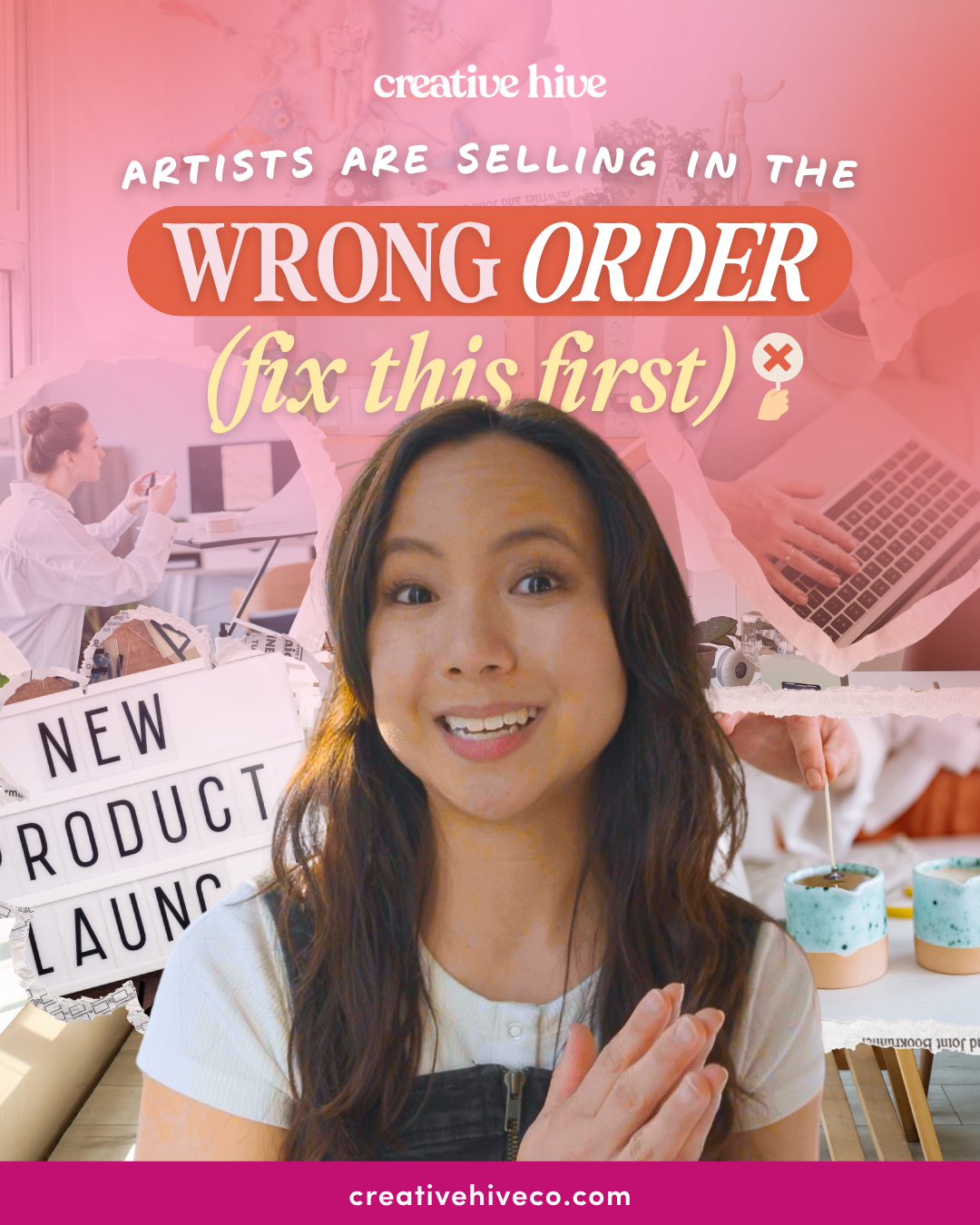
Artists are selling in the wrong order (fix this first)





Artists are selling their work in the wrong order.
They spend too much time focusing on things that should come later, and that’s why they struggle to make sales.
I’ll break down what those things are and what you should be doing instead if you want people to actually buy your work.
Mistake #1: Starting with the Product
A lot of creatives start a business by asking one simple question: “What should I make?”
From there, they spend hours designing products they personally like, something they think is cool or something they simply enjoyed creating.
Once it’s done, they open a shop and hope the right people eventually come across it.
But here’s the problem. When you start with the product first, you’re really just guessing.
You’re guessing who might want it, where those people are, and how to reach them.
And that’s exactly what makes marketing so difficult, you’re trying to find customers after the fact for something that was created in a vacuum.
There’s a much easier way to approach this. Instead of starting with the product, start with the customer.
Ask yourself:
- Who are they?
- What are they already buying?
- What kinds of things do they collect, wear, or decorate their space with?
- Where are they already spending their time so you know where to show up?
Once you have those answers, your product ideas become a lot clearer because you’re designing for a specific person, not just hoping someone out there will like what you made.
That’s exactly what I did with my first business,Tiny Hands.
I had some good years with it, but it’s also been the hardest business for me to promote and make sales from.
Why? Because I don’t really know who my customers are or how to consistently find them.
So if there’s one thing to take away from this, it’s this: decide who you’re creating for first.
Then build your product around them and you’ll find that marketing and sales become so much easier.
Mistake #2 Waiting to build an audience to sell
A lot of artists believe they need a big audience too before they can sell anything.
So they assume that once they finally launch their shop, the sales will just come naturally, they tell themselves they’ll start selling once they hit a certain number of followers.
But the problem is, that moment keeps getting pushed further and further away.
You keep posting, trying to grow, trying to get more people to notice your work but since there’s nothing to actually buy yet, people follow you for your content.
Not because they’re interested in becoming customers.
And the longer you wait to launch, the harder it becomes to actually do it.
You start putting more pressure on the moment, everything has to be perfect. The products need to be better and the photos need to be better, so you delay it again.
But launching early gives you something incredibly valuable: information. You start to see what people respond to, what they click on, and what they’re actually willing to buy. Without that feedback, you’re just guessing while trying to grow an audience at the same time.
Which brings me to the next point…
Mistake #3 Focusing on Social Media
A lot of artists treat social media like it is the business.
They spend all their time posting consistently, improving their content, chasing more likes, more views, more followers.
They focus on engagement, how to get more shares, saves, and comments.
But social media is just traffic, it’s just attention.
If someone discovers your work and likes it, what happens next? Where do they go? Is there a product page?
An email list they can join? A shop where they can easily buy your work?
If those things aren’t in place yet, all the attention you’ve worked so hard to build has nowhere to go.
People scroll past, like the post, maybe follow you and then move on.
You can spend months, even years, posting on social media, growing your audience, doing everything “right” and still not see many sales.
Not because you’re not talented or because people aren’t interested.
But because the system that turns attention into customers was never built.
Here’s the part most people skip: the sales system comes first.
Before you pour all your energy into getting more views or followers, you need a simple, clear place where someone can actually buy from you.
It doesn’t have to be fancy. It could be a basic shop page, a product listing, or even just one product.
It just needs to exist.
Think about what your customer actually experiences. They come across your work on social media, something catches their eye, so they click. Now what?
They should land on a page that shows exactly what the product is, explains it clearly, tells them the price, and makes it obvious how to buy.
That path from attention to purchase is everything.
Once that path exists, traffic finally starts to matter.
Your posts, your content, even media features now have somewhere to send people, a system that leads to a sale. Without it, all that attention doesn’t convert. It just disappears into the ether.
And this is exactly why having your own online store matters so much.
If you’re building a business you actually want to last, you don’t want everything tied to platforms you don’t control, like Etsy or TikTok Shops.
To set up your own online store, you’ll need a domain name, and that’s where .store domains come in.
If you’re starting a product-based business, a .store domain might be exactly what you need.
Let’s be real, it’s almost impossible to get your exact brand name with a .com these days but with a .store domain, your chances of getting the name you actually want are way higher.
And here’s the really interesting part. They actually ran a study comparing the exact same domain name with .store vs .com and the .store version got more clicks.
More clicks means more traffic, and more traffic means more sales.
It also makes sense when you think about it, when someone lands on a .store website, there’s already that expectation that they can buy something.
You’re naturally attracting visitors with stronger buying intent, people who are more likely to purchase, not just browse.
And it’s not just small businesses using it either. Big names like MrBeast, Michelle Obama, and even one of my favorite YouTubers, Tammy from Uncomfy, are all using .store for their websites.
So if you want to grab your own .store domain, you can head over to https://go.store/ch4 and secure yours today.
You can also use my code CREATIVEHIVE to get a .store domain for just 99 cents for your first year.
Mistake #4: Relying on Paid Ads
Speaking of traffic, if you’ve already tried the whole social media thing, you probably know it’s a lot of work. And at some point, it’s easy to think… maybe this just isn’t for me.
So naturally, paid ads start to sound really appealing.
Because you’ve heard it’s easier, more hands-off and if you get it right, it can feel like magic. Put in $1 and get back $2.
And yes, all of that is true.
But there’s a big asterisk there. A “read the fine print” kind of detail that only works if you get it right. A lot of artists see ads as a shortcut.
The thinking goes, “If my shop isn’t getting sales yet, I’ll just run some Facebook or Instagram ads and bring customers in.”
But ads don’t fix a business that isn’t working. They only amplify what’s already happening.
Think of it like this: it’s like multiplying any number by zero.
50 × 0 is still 0.
1000 × 0 is still 0.
If your product isn’t selling yet, or your website isn’t converting, ads won’t suddenly change that.
You’re just pouring more traffic into something that hasn’t been proven to work.
Now, on the flip side, if a product is already selling well organically, ads can be incredibly powerful. you can scale what’s already working.
You can get your products in front of more people who look just like your existing customers, but without that proof first, ads can quickly turn into a very expensive mistake.
Because at the end of the day, you’re paying to send more people to something that hasn’t been proven to work and that’s where most people get stuck.
So instead, it’s usually much smarter to start by seeing if your product sells through organic, free channels first:
- Think word of mouth
- Someone finding your shop through search with SEO
- And social media
Once you start seeing that people actually want what you’re selling and are willing to pay for it, that’s when ads become powerful, that’s when you can use them to grow faster.
But using ads before that point? It’s basically guessing with a credit card and that can get painful really fast.
One of my favorite ways to get traffic that actually works within this approach is media outreach.
Instead of constantly posting or spending money on ads, you get your work featured in places that already have an audience, blogs, magazines, gift guides, websites, even YouTube channels.
When they talk about your product, it does two things. First, it sends traffic directly to your shop and second, it acts as a third-party recommendation, which makes people way more likely to buy.
For example, I was recently featured on the New York Times Wirecutter for Valentine’s Day.
That feature alone brought in $18,000 in sales in February. I didn’t pay for it, and I didn’t have any personal connection to the editor.
This has honestly been one of the most effective and sustainable ways I’ve grown my businesses over the years.
And it’s exactly what I teach inside my free workshop.
If you want to check it out, you can sign up using this link: https://tinyurl.com/bddmx3b5
Mistake #5: Perfecting instead of launching
Now tell me if this sounds familiar.
You’ve had this business idea sitting in your head for ages, and you finally decide, you’re going to do it.
You start creating the product, getting everything ready and then right before you launch, that thought creeps in:
“Ugh, something’s off. It needs this. Or that. I should fix this part first.”
So you go back, you tweak the design, you adjust things, you “improve” it.
And then… you never actually put it out there.
A lot of artists get stuck here, they spend so much time trying to perfect their craft before they ever try to sell anything. The goal becomes making the product perfect first.
So you invest in better materials, you test different techniques and you spend more than you should on fancy packaging.
Because the belief is, if the product is amazing enough, people will naturally want to buy it, you’ll be successful right away, you’ll avoid failure or any embarrassing mistakes.
But what’s really happening?
It’s fear.
Because putting your work out there means risking rejection. It means facing the possibility that people might not buy. And that’s a scary place to be.
The reality is, you don’t actually know what needs improving until real people start seeing your work and interacting with it. Your customers will tell you what they care about.
Sometimes it’s the size, the price, the design sometimes, the thing you spent weeks perfecting? They don’t even notice it.
So if you wait until your product feels “perfect” before trying to sell it, you can easily spend months improving the wrong things.
It’s usually better to start selling earlier, see what people actually respond to, and then improve your product based on real feedback, not guesses.
Now, I’m not saying you should put out low-quality products but there is a balance.
One thing that helps a lot is creating a clear list of criteria for yourself, specific standards that tell you when a product is ready to sell.
That way, you know what you’re aiming for, instead of letting fear run the show because when fear takes over, it’s very easy to hide behind your craft and delay starting your store altogether.
At this point, you might be thinking, this all makes sense.
Start with the customer, launch earlier and don’t hide behind social media or your craft.
But then the next question becomes: how do you actually build the store?
Because this is where a lot of creatives get stuck again.
They overthink every step, the website, the photos, the branding, the product pages.
What should take a few days somehow turns into months of procrastinating and tweaking things that don’t really matter yet.
So in this blog, I’m going to walk you through how to build an online store so fast, it almost feels illegal.
I’ll break down the common things artists overthink when setting up their shop, how long each step should realistically take, and what to focus on instead so you can actually launch and start getting sales.
If there’s one thing to take away from all of this, it’s this: sales don’t come from doing more, they come from doing things in the right order.
Start with the customer, not the product, build a simple way to sell before chasing attention, prove your product works before trying to scale it.
And most importantly, don’t let perfection or fear keep you stuck in preparation mode.
Because the truth is, clarity only comes from action, the sooner you put something out there, the sooner you learn what actually works and that’s what turns your ideas into a real, sustainable business.

Unlock a Profitable Handmade Business
in Just 12 Weeks Without Using Etsy
or Social Media



FREE WORKSHOP
This workshop is for anyone who makes and sells a handmade or physical product, including jewelry designers, artists, paper designers, bath & body product makers and more!
What You'll Discover
The #1 mistake people make with Etsy & social media that causes shops to FLOP
The secret to making it with your handmade shop so it's no longer just a hobby
How to make sales in your handmade shop with ease so you can finally get to 6-figures
TAKE ME THERE
Your email address will not be published. Required fields are marked *






The gameplay in Subway Surfers is simple yet highly addictive. You run automatically, and your job is to navigate hazards and maximize your score.